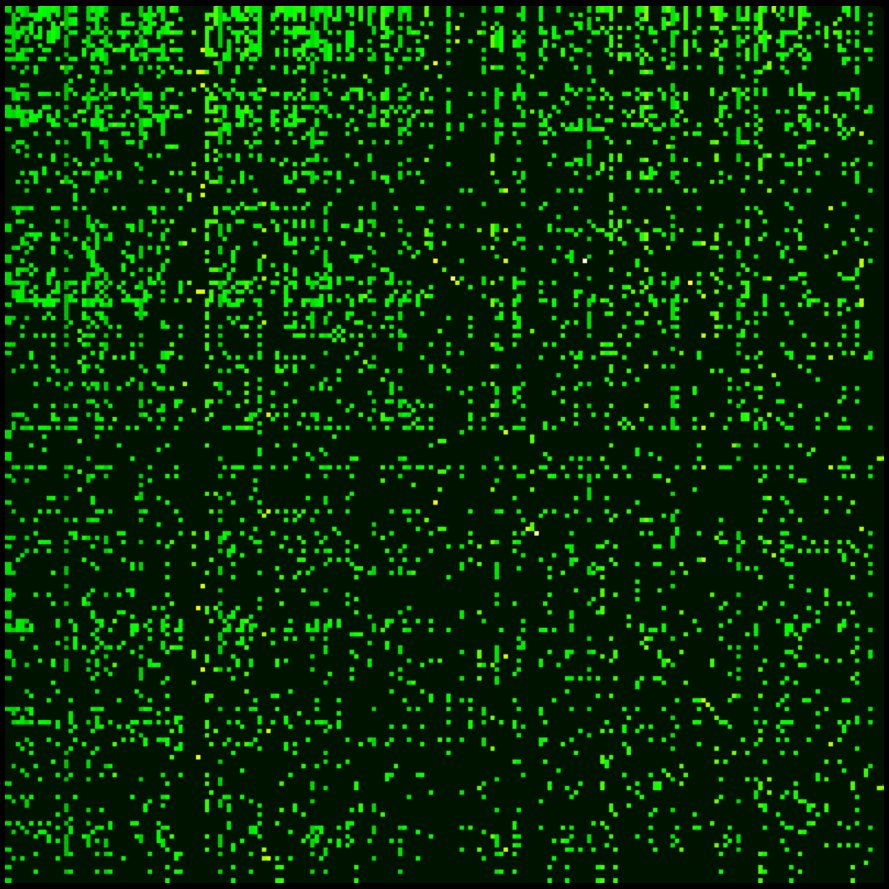
A Google matrix is a particular stochastic matrix that is used by Google's PageRank algorithm. The matrix represents a graph with edges representing links between pages. The PageRank of each page can then be generated iteratively from the Google matrix using the power method. However, in order for the power method to converge, the matrix must be stochastic, irreducible and aperiodic. == Adjacency matrix A and Markov matrix S == In order to generate the Google matrix G, we must first generate an adjacency matrix A which represents the relations between pages or nodes. Assuming there are N pages, we can fill out A by doing the following: A matrix element A i , j {\displaystyle A_{i,j}} is filled with 1 if node j {\displaystyle j} has a link to node i {\displaystyle i} , and 0 otherwise; this is the adjacency matrix of links. A related matrix S corresponding to the transitions in a Markov chain of given network is constructed from A by dividing the elements of column "j" by a number of k j = Σ i = 1 N A i , j {\displaystyle k_{j}=\Sigma _{i=1}^{N}A_{i,j}} where k j {\displaystyle k_{j}} is the total number of outgoing links from node j to all other nodes. The columns having zero matrix elements, corresponding to dangling nodes, are replaced by a constant value 1/N. Such a procedure adds a link from every sink, dangling state a {\displaystyle a} to every other node. Now by the construction the sum of all elements in any column of matrix S is equal to unity. In this way the matrix S is mathematically well defined and it belongs to the class of Markov chains and the class of Perron-Frobenius operators. That makes S suitable for the PageRank algorithm. == Construction of Google matrix G == Then the final Google matrix G can be expressed via S as: G i j = α S i j + ( 1 − α ) 1 N ( 1 ) {\displaystyle G_{ij}=\alpha S_{ij}+(1-\alpha ){\frac {1}{N}}\;\;\;\;\;\;\;\;\;\;\;(1)} By the construction the sum of all non-negative elements inside each matrix column is equal to unity. The numerical coefficient α {\displaystyle \alpha } is known as a damping factor. Usually S is a sparse matrix and for modern directed networks it has only about ten nonzero elements in a line or column, thus only about 10N multiplications are needed to multiply a vector by matrix G. == Examples of Google matrix == An example of the matrix S {\displaystyle S} construction via Eq.(1) within a simple network is given in the article CheiRank. For the actual matrix, Google uses a damping factor α {\displaystyle \alpha } around 0.85. The term ( 1 − α ) {\displaystyle (1-\alpha )} gives a surfer probability to jump randomly on any page. The matrix G {\displaystyle G} belongs to the class of Perron-Frobenius operators of Markov chains. The examples of Google matrix structure are shown in Fig.1 for Wikipedia articles hyperlink network in 2009 at small scale and in Fig.2 for University of Cambridge network in 2006 at large scale. == Spectrum and eigenstates of G matrix == For 0 < α < 1 {\displaystyle 0<\alpha <1} there is only one maximal eigenvalue λ = 1 {\displaystyle \lambda =1} with the corresponding right eigenvector which has non-negative elements P i {\displaystyle P_{i}} which can be viewed as stationary probability distribution. These probabilities ordered by their decreasing values give the PageRank vector P i {\displaystyle P_{i}} with the PageRank K i {\displaystyle K_{i}} used by Google search to rank webpages. Usually one has for the World Wide Web that P ∝ 1 / K β {\displaystyle P\propto 1/K^{\beta }} with β ≈ 0.9 {\displaystyle \beta \approx 0.9} . The number of nodes with a given PageRank value scales as N P ∝ 1 / P ν {\displaystyle N_{P}\propto 1/P^{\nu }} with the exponent ν = 1 + 1 / β ≈ 2.1 {\displaystyle \nu =1+1/\beta \approx 2.1} . The left eigenvector at λ = 1 {\displaystyle \lambda =1} has constant matrix elements. With 0 < α {\displaystyle 0<\alpha } all eigenvalues move as λ i → α λ i {\displaystyle \lambda _{i}\rightarrow \alpha \lambda _{i}} except the maximal eigenvalue λ = 1 {\displaystyle \lambda =1} , which remains unchanged. The PageRank vector varies with α {\displaystyle \alpha } but other eigenvectors with λ i < 1 {\displaystyle \lambda _{i}<1} remain unchanged due to their orthogonality to the constant left vector at λ = 1 {\displaystyle \lambda =1} . The gap between λ = 1 {\displaystyle \lambda =1} and other eigenvalue being 1 − α ≈ 0.15 {\displaystyle 1-\alpha \approx 0.15} gives a rapid convergence of a random initial vector to the PageRank approximately after 50 multiplications on G {\displaystyle G} matrix. At α = 1 {\displaystyle \alpha =1} the matrix G {\displaystyle G} has generally many degenerate eigenvalues λ = 1 {\displaystyle \lambda =1} (see e.g. [6]). Examples of the eigenvalue spectrum of the Google matrix of various directed networks is shown in Fig.3 from and Fig.4 from. The Google matrix can be also constructed for the Ulam networks generated by the Ulam method [8] for dynamical maps. The spectral properties of such matrices are discussed in [9,10,11,12,13,15]. In a number of cases the spectrum is described by the fractal Weyl law [10,12]. The Google matrix can be constructed also for other directed networks, e.g. for the procedure call network of the Linux Kernel software introduced in [15]. In this case the spectrum of λ {\displaystyle \lambda } is described by the fractal Weyl law with the fractal dimension d ≈ 1.3 {\displaystyle d\approx 1.3} (see Fig.5 from ). Numerical analysis shows that the eigenstates of matrix G {\displaystyle G} are localized (see Fig.6 from ). Arnoldi iteration method allows to compute many eigenvalues and eigenvectors for matrices of rather large size [13]. Other examples of G {\displaystyle G} matrix include the Google matrix of brain [17] and business process management [18], see also. Applications of Google matrix analysis to DNA sequences is described in [20]. Such a Google matrix approach allows also to analyze entanglement of cultures via ranking of multilingual Wikipedia articles abouts persons [21] == Historical notes == The Google matrix with damping factor was described by Sergey Brin and Larry Page in 1998 [22], see also articles on PageRank history [23], [24].
List of robotics journals
List of robotics journals includes notable academic and scientific journals that focus on research in the field of robotics and automation. == Journals == Acta Mechanica et Automatica Advanced Robotics Annual Review of Control, Robotics, and Autonomous Systems IEEE Robotics and Automation Letters IEEE Transactions on Robotics IEEE Transactions on Field Robotics The International Journal of Advanced Manufacturing Technology International Journal of Humanoid Robotics International Journal of Robotics Research Journal of Cognitive Engineering and Decision Making Journal of Field Robotics Journal of Intelligent & Robotic Systems Paladyn Robotics and Autonomous Systems Robotics Science Robotics SLAS Technology
SPL notation
SPL (Sentence Plan Language) is an abstract notation representing the semantics of a sentence in natural language. In a classical Natural Language Generation (NLG) workflow, an initial text plan (hierarchically or sequentially organized factoids, often modelled in accordance with Rhetorical Structure Theory) is transformed by a sentence planner (generator) component to a sequence of sentence plans modelled in a Sentence Plan Language. A surface generator can be used to transform the SPL notation into natural language sentences. Probably the most widely used SPL language used today (2022) is AMR (Abstract Meaning Representation, see there for further references), but is owes parts of its popularity to its application to NLP problems other than NLG, e.g., machine translation and semantic parsing.
Spleak
Spleak was an IM platform where users could publish and rate content. It existed in the form of six bots covering as many subject areas: CelebSpleak, SportSpleak, VoteSpleak, TVSpleak, GameSpleak, and StyleSpleak. == Overview == Users can add a "multi-Spleak" (which contains all of the different Spleak bots in one) or add the separate bots to their IM buddy lists on MSN and AIM. Users are also allowed access to Spleak online by using a CelebSpleak, SportSpleak, or VoteSpleak widget, or through the CelebSpleak and SportSpleak applications with Facebook. Spleak was an alternate reality game and is moving to its own company, Spleak Media Network. "Celebrate Spleak" was introduced throughout 2007, launched in 2008, and was forced to retire in 2009. == Key people == Spleak was co-founded by Morten Lund and Nicolaj Reffstrup. The company's chief executive officer is Morrie Eisenburg; Josh Scott is Vice President in Product and Tyler Wells is Vice President in Engineering.
AsoSoft text corpus
The AsoSoft text corpus is the first large-scale Kurdish text corpus, collected and processed by the AsoSoft research and development group. It contains 458,000 documents (188 million tokens) that are collected from sources such as websites, news agencies, books, and magazines. The corpus is partially tagged by topic, so it can be used for topic identification tasks. Also, it is applicable for extracting language model and computational lexicon information. Part of the corpus (75 million tokens) is available online for non-commercial use. The corpus uses the TEI format.
Lemmy (social network)
Lemmy is free and open-source, social news aggregation software for running self-hosted discussion forums. These hosts, known as "instances", communicate with each other using the ActivityPub protocol. == History == Lemmy was created by the user Dessalines on GitHub in February 2019 and licensed under the Affero General Public License. In a 2020 post, Lemmy's co-creator Dessalines wrote about the origin of the name Lemmy. "It was nameless for a long time, but I wanted to keep with the fediverse tradition of naming projects after animals. I was playing that old-school game Lemmings, and Lemmy (from Motorhead) had passed away that week, and we held a few polls for names, and I went with that." According to the Fediverse statistics sites the-federation.info and fedidb.com, Lemmy had fewer than 100 instances prior to June 2023, but grew to 455 instances with approximately 48,600 monthly active users as of 22 December 2025, with the largest instances being lemmy.world and lemmy.ml, reporting about 14,144 and 1,982 monthly active users, respectively. == Description == Lemmy is made up of a network of individual installations of the Lemmy software that can intercommunicate. This departs from the centralized, monolithic structure of other social media platforms. It has been described as a federated alternative to Reddit. Users on individual instances submit posts with links, text, or pictures to user-created forums for discussion called "communities". Discussion is in the form of threaded comments. Posts and comments can be upvoted or downvoted though the ability to downvote can be disabled by the admins of each instance. Communities are local to each instance, however users may subscribe to communities, create posts and leave comments across instances. Moderation is conducted by the administrators of each instance and moderators of specific communities. Community names begin with c/ in the URL (e.g lemmy.ml/c/simpleliving) and are mentionable using the !community@instance format. On each instance, a front page presents the user with popular posts from several communities. These posts can then be filtered according to origin: posts from the instance the user is on, or from all federated instances. It can also be made to only show posts from communities the user has subscribed to. Lemmy instances are generally supported by donations. == Relations with other social networks == ActivityPub is the protocol used to allow Lemmy instances to operate as a federated social network. It allows users to interact with compatible platforms such as Kbin and Mastodon. In June 2023, following the announcement of Reddit API service changes intended to reduce the use of third-party Reddit clients, community members discussed relocating to Lemmy and other Reddit competitors. Reddit banned a user for promoting switching to Lemmy along with the r/LemmyMigration subreddit as a whole, leading to a Streisand effect after it garnered attention on sites like Hacker News. The ban was reversed a day later. == Third-party software == Prominent third-party Reddit clients Sync and Boost which had shut down due to changes to the pricing of Reddit's API began working on Lemmy clients, with them later relaunching as Sync for Lemmy and Boost for Lemmy. Multiple other apps and browser clients have also been developed.
Pooling layer
In neural networks, a pooling layer is a kind of network layer that downsamples and aggregates information that is dispersed among many vectors into fewer vectors. It has several uses. It removes redundant information, thus reducing the amount of computation and memory required, which makes the model more robust to small variations in the input; and it increases the receptive field of neurons in later layers in the network. == Convolutional neural network pooling == Pooling is most commonly used in convolutional neural networks (CNN). Below is a description of pooling in 2-dimensional CNNs. The generalization to n-dimensions is immediate. As notation, we consider a tensor x ∈ R H × W × C {\displaystyle x\in \mathbb {R} ^{H\times W\times C}} , where H {\displaystyle H} is height, W {\displaystyle W} is width, and C {\displaystyle C} is the number of channels. A pooling layer outputs a tensor y ∈ R H ′ × W ′ × C ′ {\displaystyle y\in \mathbb {R} ^{H'\times W'\times C'}} . We define two variables f , s {\displaystyle f,s} called "filter size" (aka "kernel size") and "stride". Sometimes, it is necessary to use a different filter size and stride for horizontal and vertical directions. In such cases, we define 4 variables: f H , f W , s H , s W {\displaystyle f_{H},f_{W},s_{H},s_{W}} . The receptive field of an entry in the output tensor, y {\displaystyle y} , are all the entries in x {\displaystyle x} that can affect that entry. === Max pooling === Max Pooling (MaxPool) is commonly used in CNNs to reduce the spatial dimensions of feature maps. Define M a x P o o l ( x | f , s ) 0 , 0 , 0 = max ( x 0 : f − 1 , 0 : f − 1 , 0 ) {\displaystyle \mathrm {MaxPool} (x|f,s)_{0,0,0}=\max(x_{0:f-1,0:f-1,0})} where 0 : f − 1 {\displaystyle 0:f-1} means the range 0 , 1 , … , f − 1 {\displaystyle 0,1,\dots ,f-1} . Note that we need to avoid the off-by-one error. The next input is M a x P o o l ( x | f , s ) 1 , 0 , 0 = max ( x s : s + f − 1 , 0 : f − 1 , 0 ) {\displaystyle \mathrm {MaxPool} (x|f,s)_{1,0,0}=\max(x_{s:s+f-1,0:f-1,0})} and so on. The receptive field of y i , j , c {\displaystyle y_{i,j,c}} is x i s + f − 1 , j s + f − 1 , c {\displaystyle x_{is+f-1,js+f-1,c}} , so in general, M a x P o o l ( x | f , s ) i , j , c = m a x ( x i s : i s + f − 1 , j s : j s + f − 1 , c ) {\displaystyle \mathrm {MaxPool} (x|f,s)_{i,j,c}=\mathrm {max} (x_{is:is+f-1,js:js+f-1,c})} If the horizontal and vertical filter size and strides differ, then in general, M a x P o o l ( x | f , s ) i , j , c = m a x ( x i s H : i s H + f H − 1 , j s W : j s W + f W − 1 , c ) {\displaystyle \mathrm {MaxPool} (x|f,s)_{i,j,c}=\mathrm {max} (x_{is_{H}:is_{H}+f_{H}-1,js_{W}:js_{W}+f_{W}-1,c})} More succinctly, we can write y k = max ( { x k ′ | k ′ in the receptive field of k } ) {\displaystyle y_{k}=\max(\{x_{k'}|k'{\text{ in the receptive field of }}k\})} . If H {\displaystyle H} is not expressible as k s + f {\displaystyle ks+f} where k {\displaystyle k} is an integer, then for computing the entries of the output tensor on the boundaries, max pooling would attempt to take as inputs variables off the tensor. In this case, how those non-existent variables are handled depends on the padding conditions, illustrated on the right. Global Max Pooling (GMP) is a specific kind of max pooling where the output tensor has shape R C {\displaystyle \mathbb {R} ^{C}} and the receptive field of y c {\displaystyle y_{c}} is all of x 0 : H , 0 : W , c {\displaystyle x_{0:H,0:W,c}} . That is, it takes the maximum over each entire channel. It is often used just before the final fully connected layers in a CNN classification head. === Average pooling === Average pooling (AvgPool) is similarly defined A v g P o o l ( x | f , s ) i , j , c = a v e r a g e ( x i s : i s + f − 1 , j s : j s + f − 1 , c ) = 1 f 2 ∑ k ∈ i s : i s + f − 1 ∑ l ∈ j s : j s + f − 1 x k , l , c {\displaystyle \mathrm {AvgPool} (x|f,s)_{i,j,c}=\mathrm {average} (x_{is:is+f-1,js:js+f-1,c})={\frac {1}{f^{2}}}\sum _{k\in is:is+f-1}\sum _{l\in js:js+f-1}x_{k,l,c}} Global Average Pooling (GAP) is defined similarly to GMP. It was first proposed in Network-in-Network. Similarly to GMP, it is often used just before the final fully connected layers in a CNN classification head. === Interpolations === There are some interpolations of max pooling and average pooling. Mixed Pooling is a linear sum of max pooling and average pooling. That is, M i x e d P o o l ( x | f , s , w ) = w M a x P o o l ( x | f , s ) + ( 1 − w ) A v g P o o l ( x | f , s ) {\displaystyle \mathrm {MixedPool} (x|f,s,w)=w\mathrm {MaxPool} (x|f,s)+(1-w)\mathrm {AvgPool} (x|f,s)} where w ∈ [ 0 , 1 ] {\displaystyle w\in [0,1]} is either a hyperparameter, a learnable parameter, or randomly sampled anew every time. Lp Pooling is similar to average pooling, but uses Lp norm average instead of average: y k = ( 1 N ∑ k ′ in the receptive field of k | x k ′ | p ) 1 / p {\displaystyle y_{k}=\left({\frac {1}{N}}\sum _{k'{\text{ in the receptive field of }}k}|x_{k'}|^{p}\right)^{1/p}} where N {\displaystyle N} is the size of receptive field, and p ≥ 1 {\displaystyle p\geq 1} is a hyperparameter. If all activations are non-negative, then average pooling is the case of p = 1 {\displaystyle p=1} , and max pooling is the case of p → ∞ {\displaystyle p\to \infty } . Square-root pooling is the case of p = 2 {\displaystyle p=2} . Stochastic pooling samples a random activation x k ′ {\displaystyle x_{k'}} from the receptive field with probability x k ′ ∑ k ″ x k ″ {\displaystyle {\frac {x_{k'}}{\sum _{k''}x_{k''}}}} . It is the same as average pooling in expectation. Softmax pooling is like max pooling, but uses softmax, i.e. ∑ k ′ e β x k ′ x k ′ ∑ k ″ e β x k ″ {\displaystyle {\frac {\sum _{k'}e^{\beta x_{k'}}x_{k'}}{\sum _{k''}e^{\beta x_{k''}}}}} where β > 0 {\displaystyle \beta >0} . Average pooling is the case of β ↓ 0 {\displaystyle \beta \downarrow 0} , and max pooling is the case of β ↑ ∞ {\displaystyle \beta \uparrow \infty } Local Importance-based Pooling generalizes softmax pooling by ∑ k ′ e g ( x k ′ ) x k ′ ∑ k ″ e g ( x k ″ ) {\displaystyle {\frac {\sum _{k'}e^{g(x_{k'})}x_{k'}}{\sum _{k''}e^{g(x_{k''})}}}} where g {\displaystyle g} is a learnable function. === Other poolings === Spatial pyramidal pooling applies max pooling (or any other form of pooling) in a pyramid structure. That is, it applies global max pooling, then applies max pooling to the image divided into 4 equal parts, then 16, etc. The results are then concatenated. It is a hierarchical form of global pooling, and similar to global pooling, it is often used just before a classification head. Region of Interest Pooling (also known as RoI pooling) is a variant of max pooling used in R-CNNs for object detection. It is designed to take an arbitrarily-sized input matrix, and output a fixed-sized output matrix. Covariance pooling computes the covariance matrix of the vectors { x k , l , 0 : C − 1 } k ∈ i s : i s + f − 1 , l ∈ j s : j s + f − 1 {\displaystyle \{x_{k,l,0:C-1}\}_{k\in is:is+f-1,l\in js:js+f-1}} which is then flattened to a C 2 {\displaystyle C^{2}} -dimensional vector y i , j , 0 : C 2 − 1 {\displaystyle y_{i,j,0:C^{2}-1}} . Global covariance pooling is used similarly to global max pooling. As average pooling computes the average, which is a first-degree statistic, and covariance is a second-degree statistic, covariance pooling is also called "second-order pooling". It can be generalized to higher-order poolings. Blur Pooling means applying a blurring method before downsampling. For example, the Rect-2 blur pooling means taking an average pooling at f = 2 , s = 1 {\displaystyle f=2,s=1} , then taking every second pixel (identity with s = 2 {\displaystyle s=2} ). == Vision Transformer pooling == In Vision Transformers (ViT), there are the following common kinds of poolings. BERT-like pooling uses a dummy [CLS] token, "classification". For classification, the output at [CLS] is the classification token, which is then processed by a LayerNorm-feedforward-softmax module into a probability distribution, which is the network's prediction of class probability distribution. This is the one used by the original ViT and Masked Autoencoder. Global average pooling (GAP) does not use the dummy token, but simply takes the average of all output tokens as the classification token. It was mentioned in the original ViT as being equally good. Multihead attention pooling (MAP) applies a multi headed attention block to pooling. Specifically, it takes as input a list of vectors x 1 , x 2 , … , x n {\displaystyle x_{1},x_{2},\dots ,x_{n}} , which might be thought of as the output vectors of a layer of a ViT. It then applies a feedforward layer F F N {\displaystyle \mathrm {FFN} } on each vector, resulting in a matrix V = [ F F N ( v 1 ) , … , F F N ( v n ) ] {\displaystyle V=[\mathrm {FFN} (v_{1}),\dots ,\mathrm {FFN} (v_{n})]} . This is then sent to a multi-headed attention, resulting in M u l t i h e a d e d A