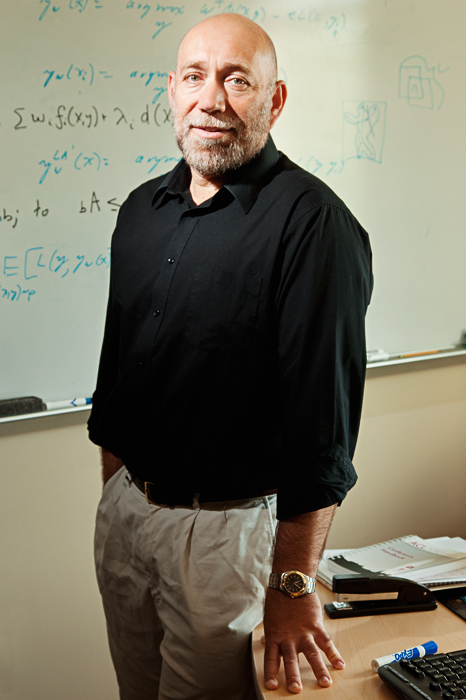
Pascale Fung (馮雁) (born in Shanghai, China) is a co-founder and Chief Research and Innovation Officer of AMI Labs, an artificial intelligence research company focused on world models. She is a professor in the Department of Electronic & Computer Engineering and the Department of Computer Science & Engineering at the Hong Kong University of Science & Technology(HKUST). She is the director of the Centre for AI Research (CAiRE) at HKUST. She is an elected Fellow of the Institute of Electrical and Electronics Engineers (IEEE) for her “contributions to human-machine interactions”, an elected Fellow of the International Speech Communication Association for “fundamental contributions to the interdisciplinary area of spoken language human-machine interactions” and an elected Fellow of the Association for Computational Linguistics (ACL) for her “significant contributions toward statistical NLP, comparable corpora, and building intelligent systems that can understand and empathize with humans”. She is a member of the Global Future Council on Artificial Intelligence and Robotics, a think tank of the World Economic Forum, and blogs for the Forum's online publication Agenda. She is a member of the Partnership on AI. She has been invited as an AI expert to different government initiatives in China, Japan, the UAE, India, the European Union and the United Nations. Fung's publication topics include spoken language systems, natural language processing, and empathetic human-robot interaction. She co-founded the Human Language Technology Center (HLTC) and is an affiliated faculty with the Robotics Institute and the Big Data Institute, both at HKUST. Additionally, she is the founding chair of the Women Faculty Association at HKUST. She is actively involved in encouraging young women into careers in engineering and science. == Career and research interests == Fung's work is focused on building systems that try to understand and empathize with humans. She has authored and co-authored hundreds of publications, along with many journal listings and book chapters. Fung is often found in the media, among others as a writer for Scientific American, the World Economic Forum, and the London School of Economics, and the Design Society. She was a pioneer in using statistical models for natural language understanding. Her PhD thesis proposed unsupervised methods for aligning texts and mining dictionary translations in different languages by distributional properties. She is an expert in spoken language understanding and computer emotional intelligence, and is a strong proponent of technology transfer. Fung has applied many of her research group's results in the fields of, among others, robotics, IoT, and financial analytics. Her efforts led to the launch of the world's first Chinese natural language search engine in 2001, the first Chinese virtual assistant for smartphones in 2010, and the first emotional intelligent speaker in 2017. == Honors == Elected Fellow, Association for the Advancement of Artificial Intelligence (AAAI), for “significant contributions to the field of Conversational AI and to the development of ethical AI principles and algorithms” Elected Fellow, Association for Computational Linguistics (ACL), for “significant contributions toward statistical NLP, comparable corpora, and building intelligent systems that can understand and empathize with humans” Nominee, the VentureBeat AI Innovation Awards at Transform 2020, for "AI for Good" Awardee, 2017 Outstanding Women Professionals & Entrepreneurs Award, Hong Kong Women Professionals & Entrepreneurs Association Elected Fellow, Institute of Electrical and Electronics Engineers (IEEE), for “contributions to human-machine interactions” Elected Fellow, International Speech Communication Association (ISCA), for “fundamental contributions to the interdisciplinary area of spoken language human-machine interactions" Member, Global Future Council on AI and Robotics, World Economic Forum (2016–) One of the Top 50 Women of Hope, selected by List Magazine in 2014 Selected as “My Favorite Teacher” by top engineering students in 2007 and in 2009 == Affiliations == Fung is affiliated with the following institutions and organizations: Hong Kong University of Science and Technology World Economic Forum Institute of Electrical and Electronics Engineers Association for Computational Linguistics International Speech Communication Association Association for Computing Machinery Association for the Advancement of Artificial Intelligence
Azure Maps
Azure Maps is a suite of cloud-based, location-based services provided by Microsoft as part of the company's Azure platform. The platform provides geospatial and location-based services via REST APIs and software development kits (SDKs). The service is typically used to integrate maps or geospatial data into applications. Azure Maps differs from Microsoft's other enterprise mapping service, Bing Maps, in its pricing model, focus on privacy, and its level of integration into the broader Azure cloud ecosystem. == History == Azure Maps was first introduced in public preview mode under the name "Azure Location Based Services" in 2017, primarily as an enterprise solution. The services was intended to add mapping and location-based functionality onto the existing Azure cloud services suite, seen as a critical part of Microsoft's broader Internet-of-Things (IoT) strategy. The preview version included APIs which could be used to develop location aware apps for use cases such as logistics and mobility. In 2018, the software was renamed "Azure Maps," and became generally available to the public, and a number of new functions were added, including route calculation, travel time calculation, and incorporation of real-time traffic data and incident information. Azure Maps was integrated with Azure IoT Central in 2018, which added tracking, monitoring, and geofencing capabilities. A set of mobility APIs on were added in 2019, with applications such as use in public transport apps and shared bicycle fleet management. “Azure Maps Creator,” which converts private facility floor plans into indoor map data, was also introduced in 2019. Some commentators linked these services to Microsoft's broader development of augmented reality products. In 2020, Azure Maps Visual for Power BI was released, integrating location-based features and mapping capabilities into Microsoft's business intelligence software. An elevation API (which was later retired), geolocation services, and an iOS and Android software development kit were introduced in 2021. In 2022, support for historical weather, air quality, and tropical storm data was made generally available and custom styling for indoor maps was also introduced. In 2023, Azure Maps was certified as HIPAA compliant in a move to target healthcare and health insurance companies. == Functionality == === Geocoding === Geocoding is one of the core functionalities of Azure Maps, converting addresses or place names into geographic coordinates. Batch geocoding is used to process large amounts of address data, a function used for route optimization and spatial analysis. === Reverse geocoding === Reverse geocoding derives human-readable information from geographic coordinates like longitude and latitude, used in navigation and by geographic information systems. === Routing === Azure Maps uses map data and routing algorithms to calculate the shortest or fastest routes between locations based on factors like vehicle size and type, traffic conditions, and distance. Routing also supports multi-modal routing, which include multiple modes of transport in a single trip, including cycling, walking, and ferries. This functionality is used for location-based searches and route optimization in applications like fleet management, proximity marketing, and emergency services as well as logistics and delivery, urban planning, ride sharing apps, and outdoor activities. === Map visualization === The platform supports map visualizations that can be modified to reflect real-time data (including from IoT sensors) as well as historical data patterns. Visualizations include heat maps, street maps, satellite imagery and other custom data layers. Maps are rendered using raster or vector tiles which reduce the load of displaying large data sets or complex maps. This can be used in various applications in areas like transportation, smart cities, retail and marketing, public health, and environmental monitoring. For example, it can be used for tracking the spread of diseases or measuring the impact of changing climatic patterns. === Geofencing and spatial analytics === Azure Maps supports polygonal geofencing, which enables the definition of custom geographic boundaries. Geofenced areas can be monitored in real-time for events of interest. For example, an application could send an alert when equipment or persons enter or leave a defined area. Tools for analyzing historical geofencing data are also available via the APIs for optimization purposes. == Industry usage == Azure Maps' geofencing function has seen usage in the construction industry, designating hazardous areas for safety purposes and sending alerts if anyone enters the area. Private facility maps are used by construction companies for monitoring large construction sites to increase productivity and prevent accidents or damage. In emergency management, New Zealand based company Beca has used Azure Maps to provide analysis on the impact of earthquakes to users, including information on the severity and location of an earthquake and the impact on affected properties. Alaska's Department of Transportation uses Azure Maps as part of an information system providing weather-related warnings and analytics to road crews. Airmap, an airspace management platform for drones, uses Azure Maps. Azure Maps has also been used in conjunction with Azure Monitor for risk monitoring by an insurance company. Other companies that use or have used Azure Maps include BMW, Banco Santander, Jvion, MV Transportation, C.H. Robertson, Wise Skulls, Tata Consultancy Services, Providence Health and Services, Gas Brasiliano Distribuidora S.A., Shell plc, Persistent Systems, Phase 2 Dining and Entertainment, Symbio, HID, Globant, and Insight Enterprises. == Partnerships == Azure Maps and TomTom have been partners since 2016, and TomTom provides location data to Azure Maps and can process data from Azure Maps for mapping purposes. In 2021, Azure Maps partnered with AccuWeather to make climatic data available via its APIs, making weather data along all parts of calculated routes available for mobility and logistics purposes. Microsoft has partnered with Esri, the developer of ArcGIS, and there is cross-compatibility between Azure and ArcGIS so that data from Azure Maps can be integrated into ArcGIS and vice versa. Azure Maps partnered with Moovit in 2019, a startup providing software that interfaces with public transport data. Moovit's database on global public transit networks, including information on which stations and facilities are wheelchair accessible, was linked to Azure Maps. This service was noted for its use increasing accessibility to public transport for the visually impaired by means of voice activated route planning assistance. NORAD has used some Azure Maps functions for their NORAD Tracks Santa website during Christmas holidays. == Components == === REST APIs === Various APIs cover the major functionalities across Azure Maps: Data registry API Geolocation API Render API Route API Search API Spatial API Time zone API Traffic API Weather API === SDKs === Azure Maps SDKs uses MapLibre-style specifications and open source MapLibre GL-based libraries as a rendering engine. The Web SDK is used for developing web apps with maps and location-based data and functionality. It includes a map control module as well as modules with drawing tools. It also supports Azure Maps Creator and various spatial data formats. The platform also includes a set of REST SDKs for developers integrating Azure Maps REST APIs into Python, C#, Java or JavaScript applications. Azure Maps also includes Android and iOS SDKs used for developing applications for Android and Apple devices. === Azure Maps Creator === Azure Maps Creator is a tool for generating custom maps for locations like large office complexes, construction sites, or university campuses. These maps can then be integrated into applications and used with other Azure Maps functions for purposes such as wayfinding and maintenance and security in building automation contexts. === Azure Maps Visual for Power BI === Azure Maps is integrated with Microsoft Power BI, a graphical tool for producing data visualizations. Since July 2020, Power BI can be used in conjunction with Azure Maps for developing map-based data visualizations. This functionality entered general availability in May 2023.
ChromaDB
Chroma or ChromaDB is open-source data infrastructure tailored to applications with large language models. Its headquarters are in San Francisco. In April 2023, it raised 18 million US dollars as seed funding. ChromaDB has been used in academic studies on artificial intelligence, particularly as part of the tech stack for retrieval-augmented generation.
Pandorabots
Pandorabots, Inc. is an artificial intelligence company that runs a web service for building and deploying chatbots. Pandorabots implements and supports development of the Artificial Intelligence Markup Language and makes portions of its code accessible for free. The Pandorabots Platform is "one of the oldest and largest chatbot hosting services in the world", allowing creation of virtual agents to hold human-like text or voice chats with consumers. The platform is written in Allegro Common LISP. == Use Cases == Common use cases include advertising, virtual assistance, e-learning, entertainment and education. The platform has also been used by academics and universities use the platform for teaching and research.
KidDesk
KidDesk is an alternative desktop software application. The early childhood learning company Hatch Early Childhood created KidDesk; it subsequently went to Edmark, which was bought by IBM then sold to Riverdeep (now Houghton Mifflin Harcourt Learning Technology). KidDesk is compatible with Microsoft Windows 95 and newer, as well as Apple System 7 and newer. KidDesk can be set to start when the computer starts up, and can only be exited through password entry. Adults choose what programs are included for the child to use, what icon represented the desk, and customize the software programs available for use. == History == Edmark first started shipping KidDesk in 1992. In 1993, Edmark updated KidDesk with KidDesk Family Edition for Macintosh and DOS, adding more desk accessories and desk styles (Sometimes included as a free exclusive offer with the Early Learning House and Thinkin' Things Series). In 1995, KidDesk Family Edition was enhanced for Windows 95, and released one month after the new operating system shipped. In 1998, Edmark developed KidDesk Internet Safe. The Internet Safe edition was written for Windows 95, Windows 98, and Macintosh (including OS8). In 2008, HMH ported KidDesk Family Edition was to run on Windows Vista and in 2011 version 3.07 of KidDesk Family Edition was released as part of the 'Young Explorer' suite which is fully supported on Windows XP, Windows Vista and Windows 7. == Features == A picture editor incorporated into the desk. Used both in the Adult settings menu and in the desk itself. KidDesk users can edit their user logo with a pixel grid paint program. A calendar incorporated into the desk. This allows the user to set dates that the user finds important, and allows the date to be marked with a picture or text. A password exit feature. For security reasons, the adult can set a password so that KidDesk can only be exited if it is entered. As an extra security measure, the password exit function could only be accessed if the user pressed the ctrl + alt + A keyboard buttons simultaneously. A skin changer with several themes - farm, princess, sports, ocean, etc. These themes can be changed. The e-mail and voicemail features are customizable depending on the KidDesk installation. The ability to add websites that can be accessed on KidDesk, and the ability to block hyperlinks, JavaScript, data entry, etc., on said sites was an added for the 'Internet Safe' edition released in 1998. KidDesk Internet Safe edition is available in Spanish and Brazilian-Portuguese versions. == Reception == KidDesk was given a platinum award at the 1994 Oppenheim Toy Portfolio Awards. The judges praised the program's security features allowing "configur[ation] so that kids never have access to the possibly destructive DOS prompt", and concluded that "[i]f you and your kids share a computer, you need to install Kiddesk immediately!" === Awards === Since 1992, KidDesk has won 15 major awards.
Expectation propagation
Expectation propagation (EP) is a technique in Bayesian machine learning. EP finds approximations to a probability distribution. It uses an iterative approach that uses the factorization structure of the target distribution. It differs from other Bayesian approximation approaches such as variational Bayesian methods. More specifically, suppose we wish to approximate an intractable probability distribution p ( x ) {\displaystyle p(\mathbf {x} )} with a tractable distribution q ( x ) {\displaystyle q(\mathbf {x} )} . Expectation propagation achieves this approximation by minimizing the Kullback–Leibler divergence K L ( p | | q ) {\displaystyle \mathrm {KL} (p||q)} . Variational Bayesian methods minimize K L ( q | | p ) {\displaystyle \mathrm {KL} (q||p)} instead. If q ( x ) {\displaystyle q(\mathbf {x} )} is a Gaussian N ( x | μ , Σ ) {\displaystyle {\mathcal {N}}(\mathbf {x} |\mu ,\Sigma )} , then K L ( p | | q ) {\displaystyle \mathrm {KL} (p||q)} is minimized with μ {\displaystyle \mu } and Σ {\displaystyle \Sigma } being equal to the mean of p ( x ) {\displaystyle p(\mathbf {x} )} and the covariance of p ( x ) {\displaystyle p(\mathbf {x} )} , respectively; this is called moment matching. == Applications == Expectation propagation via moment matching plays a vital role in approximation for indicator functions that appear when deriving the message passing equations for TrueSkill.
Connected-component labeling
Connected-component labeling (CCL), connected-component analysis (CCA), blob extraction, region labeling, blob discovery, or region extraction is an algorithmic application of graph theory, where subsets of connected components are uniquely labeled based on a given heuristic. Connected-component labeling is not to be confused with segmentation. Connected-component labeling is used in computer vision to detect connected regions in binary digital images, although color images and data with higher dimensionality can also be processed. When integrated into an image recognition system or human-computer interaction interface, connected component labeling can operate on a variety of information. Blob extraction is generally performed on the resulting binary image from a thresholding step, but it can be applicable to gray-scale and color images as well. Blobs may be counted, filtered, and tracked. Blob extraction is related to but distinct from blob detection. == Overview == A graph, containing vertices and connecting edges, is constructed from relevant input data. The vertices contain information required by the comparison heuristic, while the edges indicate connected 'neighbors'. An algorithm traverses the graph, labeling the vertices based on the connectivity and relative values of their neighbors. Connectivity is determined by the medium; image graphs, for example, can be 4-connected neighborhood or 8-connected neighborhood. Following the labeling stage, the graph may be partitioned into subsets, after which the original information can be recovered and processed . == Definition == The usage of the term connected-component labeling (CCL) and its definition is quite consistent in the academic literature, whereas connected-component analysis (CCA) varies both in terminology and in its definition of the problem. Rosenfeld et al. define connected components labeling as the “[c]reation of a labeled image in which the positions associated with the same connected component of the binary input image have a unique label.” Shapiro et al. define CCL as an operator whose “input is a binary image and [...] output is a symbolic image in which the label assigned to each pixel is an integer uniquely identifying the connected component to which that pixel belongs.” There is no consensus on the definition of CCA in the academic literature. It is often used interchangeably with CCL. A more extensive definition is given by Shapiro et al.: “Connected component analysis consists of connected component labeling of the black pixels followed by property measurement of the component regions and decision making.” The definition for connected-component analysis presented here is more general, taking the thoughts expressed in into account. == Algorithms == The algorithms discussed can be generalised to arbitrary dimensions, albeit with increased time and space complexity. === One component at a time === This is a fast and very simple method to implement and understand. It is based on graph traversal methods in graph theory. In short, once the first pixel of a connected component is found, all the connected pixels of that connected component are labelled before going onto the next pixel in the image. This algorithm is part of Vincent and Soille's watershed segmentation algorithm, other implementations also exist. In order to do that a linked list is formed that will keep the indexes of the pixels that are connected to each other, steps (2) and (3) below. The method of defining the linked list specifies the use of a depth or a breadth first search. For this particular application, there is no difference which strategy to use. The simplest kind of a last in first out queue implemented as a singly linked list will result in a depth first search strategy. It is assumed that the input image is a binary image, with pixels being either background or foreground and that the connected components in the foreground pixels are desired. The algorithm steps can be written as: Start from the first pixel in the image. Set current label to 1. Go to (2). If this pixel is a foreground pixel and it is not already labelled, give it the current label and add it as the first element in a queue, then go to (3). If it is a background pixel or it was already labelled, then repeat (2) for the next pixel in the image. Pop out an element from the queue, and look at its neighbours (based on any type of connectivity). If a neighbour is a foreground pixel and is not already labelled, give it the current label and add it to the queue. Repeat (3) until there are no more elements in the queue. Go to (2) for the next pixel in the image and increment current label by 1. Note that the pixels are labelled before being put into the queue. The queue will only keep a pixel to check its neighbours and add them to the queue if necessary. This algorithm only needs to check the neighbours of each foreground pixel once and doesn't check the neighbours of background pixels. The pseudocode is: algorithm OneComponentAtATime(data) input : imageData[xDim][yDim] initialization : label = 0, labelArray[xDim][yDim] = 0, statusArray[xDim][yDim] = false, queue1, queue2; for i = 0 to xDim do for j = 0 to yDim do if imageData[i][j] has not been processed do if imageData[i][j] is a foreground pixel do check its four neighbors(north, south, east, west) : if neighbor is not processed do if neighbor is a foreground pixel do add it to queue1 else update its status to processed end if labelArray[i][j] = label (give label) statusArray[i][j] = true (update status) while queue1 is not empty do For each pixel in the queue do : check its four neighbors if neighbor is not processed do if neighbor is a foreground pixel do add it to queue2 else update its status to processed end if give it the current label update its status to processed remove the current element from queue1 copy queue2 into queue1 end While increase the label end if else update its status to processed end if end if end if end for end for === Two-pass === Relatively simple to implement and understand, the two-pass algorithm, (also known as the Hoshen–Kopelman algorithm) iterates through 2-dimensional binary data. The algorithm makes two passes over the image: the first pass to assign temporary labels and record equivalences, and the second pass to replace each temporary label by the smallest label of its equivalence class. The input data can be modified in situ (which carries the risk of data corruption), or labeling information can be maintained in an additional data structure. Connectivity checks are carried out by checking neighbor pixels' labels (neighbor elements whose labels are not assigned yet are ignored), or say, the north-east, the north, the north-west and the west of the current pixel (assuming 8-connectivity). 4-connectivity uses only north and west neighbors of the current pixel. The following conditions are checked to determine the value of the label to be assigned to the current pixel (4-connectivity is assumed) Conditions to check: Does the pixel to the left (west) have the same value as the current pixel? Yes – We are in the same region. Assign the same label to the current pixel No – Check next condition Do both pixels to the north and west of the current pixel have the same value as the current pixel but not the same label? Yes – We know that the north and west pixels belong to the same region and must be merged. Assign the current pixel the minimum of the north and west labels, and record their equivalence relationship No – Check next condition Does the pixel to the left (west) have a different value and the one to the north the same value as the current pixel? Yes – Assign the label of the north pixel to the current pixel No – Check next condition Do the pixel's north and west neighbors have different pixel values than current pixel? Yes – Create a new label id and assign it to the current pixel The algorithm continues this way, and creates new region labels whenever necessary. The key to a fast algorithm, however, is how this merging is done. This algorithm uses the union-find data structure which provides excellent performance for keeping track of equivalence relationships. Union-find essentially stores labels which correspond to the same blob in a disjoint-set data structure, making it easy to remember the equivalence of two labels by the use of an interface method E.g.: findSet(l). findSet(l) returns the minimum label value that is equivalent to the function argument 'l'. Once the initial labeling and equivalence recording is completed, the second pass merely replaces each pixel label with its equivalent disjoint-set representative element. A faster-scanning algorithm for connected-region extraction is presented below. On the first pass: Iterate through each element of the data by column, then by row (Raster Scanning) If the element is not the background Get the neighboring elements of the current element If there are no neighbors, uniquely