The region connection calculus (RCC) is intended to serve for qualitative spatial representation and reasoning. RCC abstractly describes regions (in Euclidean space, or in a topological space) by their possible relations to each other. RCC8 consists of 8 basic relations that are possible between two regions: disconnected (DC) externally connected (EC) equal (EQ) partially overlapping (PO) tangential proper part (TPP) tangential proper part inverse (TPPi) non-tangential proper part (NTPP) non-tangential proper part inverse (NTPPi) From these basic relations, combinations can be built. For example, proper part (PP) is the union of TPP and NTPP. == Axioms == RCC is governed by two axioms. for any region x, x connects with itself for any region x, y, if x connects with y, y connects with x == Remark on the axioms == The two axioms describe two features of the connection relation, but not the characteristic feature of the connect relation. For example, we can say that an object is less than 10 meters away from itself and that if object A is less than 10 meters away from object B, object B will be less than 10 meters away from object A. So, the relation 'less-than-10-meters' also satisfies the above two axioms, but does not talk about the connection relation in the intended sense of RCC. == Composition table == The composition table of RCC8 are as follows: "" denotes the universal relation, no relation can be discarded. Usage example: if a TPP b and b EC c, (row 4, column 2) of the table says that a DC c or a EC c. == Examples == The RCC8 calculus is intended for reasoning about spatial configurations. Consider the following example: two houses are connected via a road. Each house is located on an own property. The first house possibly touches the boundary of the property; the second one surely does not. What can we infer about the relation of the second property to the road? The spatial configuration can be formalized in RCC8 as the following constraint network: house1 DC house2 house1 {TPP, NTPP} property1 house1 {DC, EC} property2 house1 EC road house2 { DC, EC } property1 house2 NTPP property2 house2 EC road property1 { DC, EC } property2 road { DC, EC, TPP, TPPi, PO, EQ, NTPP, NTPPi } property1 road { DC, EC, TPP, TPPi, PO, EQ, NTPP, NTPPi } property2 Using the RCC8 composition table and the path-consistency algorithm, we can refine the network in the following way: road { PO, EC } property1 road { PO, TPP } property2 That is, the road either overlaps (PO) property2, or is a tangential proper part of it. But, if the road is a tangential proper part of property2, then the road can only be externally connected (EC) to property1. That is, road PO property1 is not possible when road TPP property2. This fact is not obvious, but can be deduced once we examine the consistent "singleton-labelings" of the constraint network. The following paragraph briefly describes singleton-labelings. First, we note that the path-consistency algorithm will also reduce the possible properties between house2 and property1 from { DC, EC } to just DC. So, the path-consistency algorithm leaves multiple possible constraints on 5 of the edges in the constraint network. Since each of the multiple constraints involves 2 constraints, we can reduce the network to 32 (25) possible unique constraint networks, each containing only single labels on each edge ("singleton labelings"). However, of the 32 possible singleton labelings, only 9 are consistent. (See qualreas for details.) Only one of the consistent singleton labelings has the edge road TPP property2 and the same labeling includes road EC property1. Other versions of the region connection calculus include RCC5 (with only five basic relations - the distinction whether two regions touch each other are ignored) and RCC23 (which allows reasoning about convexity). == RCC8 use in GeoSPARQL == RCC8 has been partially implemented in GeoSPARQL as described below: == Implementations == GQR is a reasoner for RCC-5, RCC-8, and RCC-23 (as well as other calculi for spatial and temporal reasoning) qualreas is a Python framework for qualitative reasoning over networks of relation algebras, such as RCC-8, Allen's interval algebra and more.
Generatrix
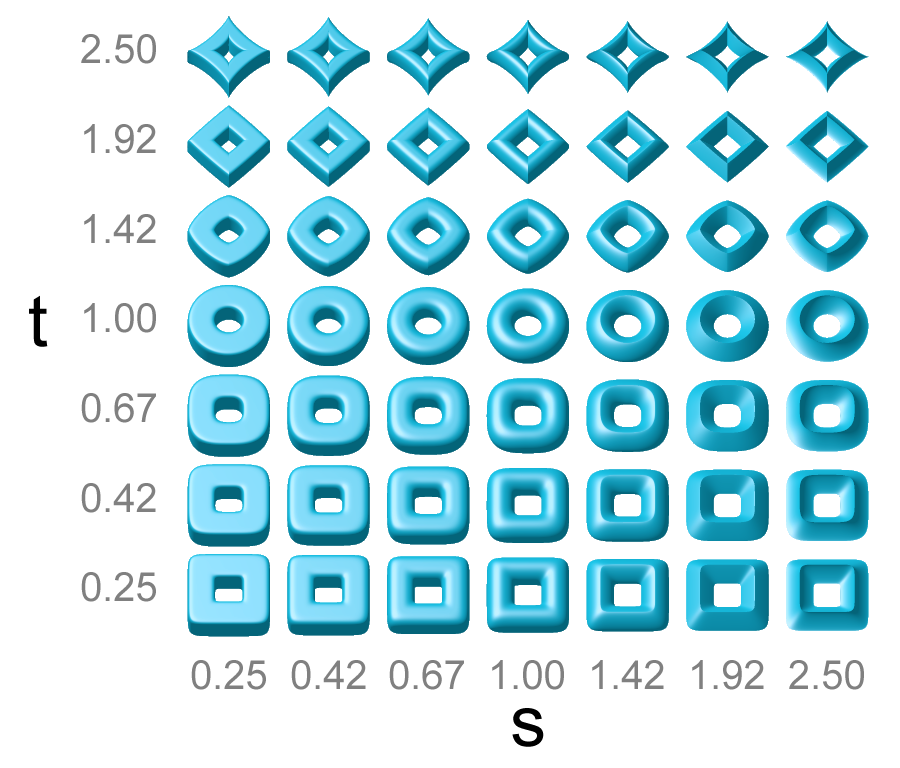
In geometry, a generatrix () or describent is a point, curve or surface that, when moved along a given path, generates a new shape. The path directing the motion of the generatrix motion is called a directrix or dirigent. == Examples == A cone can be generated by moving a line (the generatrix) fixed at the future apex of the cone along a closed curve (the directrix); if that directrix is a circle perpendicular to the line connecting its center to the apex, the motion is rotation around a fixed axis and the resulting shape is a circular cone. The generatrix of a cylinder, a limiting case of a cone, is a line that is kept parallel to some axis.
CENDI
CENDI (Commerce, Energy, NASA, Defense Information Managers Group) is an interagency group of senior Scientific and Technical Information (STI) managers from 14 United States federal agencies. CENDI managers cooperate by exchanging information and ideas, collaborating to address common issues, and undertaking joint initiatives. CENDI's accomplishments range from impacting federal information policy to educating a broad spectrum of stakeholders on all aspects of federal STI systems, including its value to research and the taxpayer, and to operational improvements in agency and interagency STI operations. == History == CENDI traces its roots to the Committee on Scientific and Technical Information (COSATI) of the Federal Council on Science and Technology. COSATI was established in the early 1960s to coordinate the management of the results from the U.S. government's increasing commitment to scientific research and technology development. The scientific and technical information (STI) managers of the government's major research and development (R&D) agencies worked within COSATI to standardize guidelines for cataloging and indexing technical reports. COSATI ceased formal operations in the early 1970s. To continue the cooperation begun under COSATI, managers of agency STI programs from Commerce (National Technical Information Service), Energy (Office of Scientific and Technical Information), NASA (HQ/STI Division), and Defense (Defense Technical Information Center) began meeting periodically to discuss common topics and stimulate more effective cooperation. In 1985, a Memorandum of Understanding was signed by the four charter agencies and CENDI was established. From this small core of STI managers, CENDI has grown to its current membership, which represents the major science agencies, the national libraries, and agencies involved in the dissemination and long-term management of scientific and technical information. The vision of CENDI is to facilitate cooperative enterprise where capabilities are shared and challenges are faced together so that the sum of the accomplishments is greater than each individual agency can achieve on its own amongst federal STI agencies. The abbreviation CENDI refers to the "Commerce, Energy, NASA, Defense Information Managers Group". == Membership == New members from other federal R&D information organizations may be admitted by unanimous agreement of the members. However, it is the intent of the group that membership in CENDI should remain small and focus on organizations with STI or supporting responsibilities. Each agency provides funding to CENDI. == Members == The members of CENDI are: Defense Technical Information Center (United States Department of Defense) Office of Research and Development and Office of Environmental Information (United States Environmental Protection Agency) Government Printing Office Library of Congress NASA Scientific and Technical Information Program National Agricultural Library (United States Department of Agriculture) National Archives and Records Administration National Library of Education (United States Department of Education) National Library of Medicine (United States Department of Health and Human Services) National Science Foundation National Technical Information Service (United States Department of Commerce) National Transportation Library (United States Department of Transportation) Office of Scientific and Technical Information (United States Department of Energy) USGS/Biological Resources Discipline (United States Department of the Interior) == Mission and operation == CENDI's mission is to help improve the productivity of federal science- and technology-based programs through effective scientific, technical, and related information support systems. In fulfilling its mission, CENDI agencies play an important role in addressing science- and technology-based national priorities and strengthening U.S. competitiveness. === Goals === STI Coordination and Leadership: Provide coordination and leadership for information exchange on important STI policy issues. Improvement of STI Systems: Promote the development of improved STI systems through the productive interrelationship of content and technology. STI Understanding: Promote better understanding of STI and STI management. === Principals and Alternates === CENDI is made up of senior federal STI managers and each organization appoints a Principal representative. This person is the point of contact for that organization within CENDI. Each Principal has an Alternate. The Principals and Alternates comprise the main group that meets on a regular basis, usually every other month. === Secretariat === A Tennessee-based information management company, -- Information International Associates, Inc., currently serves as the CENDI Secretariat. The Secretariat provides day-to-day operations to CENDI. The Secretariat prepares the necessary materials for the Principals' meetings, provides support for the working group and task group meetings, assists in developing papers, and maintains the CENDI files and outreach tools. === Task Groups and Working Groups === The chair(s) of a working group is appointed by the Principals and has the overall responsibility for the group's activities. The Secretariat provides support at the request of the Working Group chair(s). The Working Groups and Task Groups that are currently operating are: Copyright and Intellectual Property Working Group Distribution Markings Task Group Digital Preservation Task Group Digitization Specifications Task Group Image Metadata Task Group Science.gov (see below) STI Policy Working Group Terminology Resources Task Group === Science.gov and Worldwidescience.org === In 2001, in response to the April 2001 workshop on "Strengthening the Public Information Infrastructure for Science", and taking into consideration a request from Firstgov (now USA.gov) to develop specialized topical portals, CENDI formed an alliance to develop an interagency website for access to STI. This website, called Science.gov, is a one-stop source of STI, including both selected, authoritative government websites and deep Web databases of technical reports, journal articles, conference proceedings, and other published materials. Through the volunteer efforts of members and involving over 100 staff, content and architecture is developed for the site. The Science.gov website is hosted by the Department of Energy (DOE) Office of Scientific and Technical Information (OSTI). The site was formally launched in December 2002. As a result of the success of Science.gov, under DOE leadership and in cooperation with the International Council of Scientific and Technical Information, a worldwide coordination across national portals called WorldWideScience was launched in 2008. === Work with non-member organizations === CENDI works with several cooperating non-member organizations on a regular basis. These agencies are in academia, federal government, legal and policy analysis, international, non-governmental, and private organizations.
In-place algorithm
In computer science, an in-place algorithm is an algorithm that operates directly on the input data structure without requiring extra space proportional to the input size. In other words, it modifies the input in place, without creating a separate copy of the data structure. An algorithm which is not in-place is sometimes called not-in-place or out-of-place. In-place can have slightly different meanings. In its strictest form, the algorithm can only have a constant amount of extra space, counting everything including function calls and pointers. However, this form is very limited as simply having an index to a length n array requires O(log n) bits. More broadly, in-place means that the algorithm does not use extra space for manipulating the input but may require a small though non-constant extra space for its operation. Usually, this space is O(log n), though sometimes anything in o(n) is allowed. Note that space complexity also has varied choices in whether or not to count the index lengths as part of the space used. Often, the space complexity is given in terms of the number of indices or pointers needed, ignoring their length. In this article, we refer to total space complexity (DSPACE), counting pointer lengths. Therefore, the space requirements here have an extra log n factor compared to an analysis that ignores the lengths of indices and pointers. An algorithm may or may not count the output as part of its space usage. Since in-place algorithms usually overwrite their input with output, no additional space is needed. When writing the output to write-only memory or a stream, it may be more appropriate to only consider the working space of the algorithm. In theoretical applications such as log-space reductions, it is more typical to always ignore output space (in these cases it is more essential that the output is write-only). == Examples == Given an array a of n items, suppose we want an array that holds the same elements in reversed order and to dispose of the original. One seemingly simple way to do this is to create a new array of equal size, fill it with copies from a in the appropriate order and then delete a. function reverse(a[0..n - 1]) allocate b[0..n - 1] for i from 0 to n - 1 b[n − 1 − i] := a[i] return b Unfortunately, this requires O(n) extra space for having the arrays a and b available simultaneously. Also, allocation and deallocation are often slow operations. Since we no longer need a, we can instead overwrite it with its own reversal using this in-place algorithm which will only need constant number (2) of integers for the auxiliary variables i and tmp, no matter how large the array is. function reverse_in_place(a[0..n-1]) for i from 0 to floor((n-2)/2) tmp := a[i] a[i] := a[n − 1 − i] a[n − 1 − i] := tmp As another example, many sorting algorithms rearrange arrays into sorted order in-place, including: bubble sort, comb sort, selection sort, insertion sort, heapsort, and Shell sort. These algorithms require only a few pointers, so their space complexity is O(log n). Quicksort operates in-place on the data to be sorted. However, quicksort requires O(log n) stack space pointers to keep track of the subarrays in its divide and conquer strategy. Consequently, quicksort needs O(log2 n) additional space. Although this non-constant space technically takes quicksort out of the in-place category, quicksort and other algorithms needing only O(log n) additional pointers are usually considered in-place algorithms. Most selection algorithms are also in-place, although some considerably rearrange the input array in the process of finding the final, constant-sized result. Some text manipulation algorithms such as trim and reverse may be done in-place. == In computational complexity == In computational complexity theory, the strict definition of in-place algorithms includes all algorithms with O(1) space complexity, the class DSPACE(1). This class is very limited; it equals the regular languages. In fact, it does not even include any of the examples listed above. Algorithms are usually considered in L, the class of problems requiring O(log n) additional space, to be in-place. This class is more in line with the practical definition, as it allows numbers of size n as pointers or indices. This expanded definition still excludes quicksort, however, because of its recursive calls. Identifying the in-place algorithms with L has some interesting implications; for example, it means that there is a (rather complex) in-place algorithm to determine whether a path exists between two nodes in an undirected graph, a problem that requires O(n) extra space using typical algorithms such as depth-first search (a visited bit for each node). This in turn yields in-place algorithms for problems such as determining if a graph is bipartite or testing whether two graphs have the same number of connected components. == Role of randomness == In many cases, the space requirements of an algorithm can be drastically cut by using a randomized algorithm. For example, if one wishes to know if two vertices in a graph of n vertices are in the same connected component of the graph, there is no known simple, deterministic, in-place algorithm to determine this. However, if we simply start at one vertex and perform a random walk of about 20n3 steps, the chance that we will stumble across the other vertex provided that it is in the same component is very high. Similarly, there are simple randomized in-place algorithms for primality testing such as the Miller–Rabin primality test, and there are also simple in-place randomized factoring algorithms such as Pollard's rho algorithm. == In functional programming == Functional programming languages often discourage or do not support explicit in-place algorithms that overwrite data, since this is a type of side effect; instead, they only allow new data to be constructed. However, good functional language compilers will often recognize when an object very similar to an existing one is created and then the old one is thrown away, and will optimize this into a simple mutation "under the hood". Note that it is possible in principle to carefully construct in-place algorithms that do not modify data (unless the data is no longer being used), but this is rarely done in practice.
System of record
A system of record (SOR) or source system of record (SSoR) is a data management term for an information storage system (commonly implemented on a computer system running a database management system) that is the authoritative data source for a given data element or piece of information, like for example a row (or record) in a table. In data vault it is referred to as the record source. == Background == The need to identify systems of record can become acute in organizations where management information systems have been built by taking output data from multiple source systems, re-processing this data, and then re-presenting the result for a new business use. In these cases, multiple information systems may disagree about the same piece of information. These disagreements may stem from semantic differences, differences in opinion, use of different sources, differences in the timing of the extract, transform, load processes that create the data they report against, or may simply be the result of bugs. == Use == The integrity and validity of any data set is open to question when there is no traceable connection to a good source, and listing a source system of record is a solution to this. Where the integrity of the data is vital, if there is an agreed system of record, the data element must either be linked to, or extracted directly from it. In other cases, the provenance and estimated data quality should be documented. The "system of record" approach is a good fit for environments where both: there is a single authority over all data consumers, and all consumers have similar needs == Trade-offs == In diverse environments, one instead needs to support the presence of multiple opinions. Consumers may accept different authorities or may differ on what constitutes an authoritative source—researchers may prefer carefully vetted data, while tactical military systems may require the most recent credible report.
Statistical learning theory
Statistical learning theory is a framework for machine learning drawing from the fields of statistics and functional analysis. Statistical learning theory deals with the statistical inference problem of finding a predictive function based on data. Statistical learning theory has led to successful applications in fields such as computer vision, speech recognition, and bioinformatics. == Introduction == The goals of learning are understanding and prediction. Learning falls into many categories, including supervised learning, unsupervised learning, online learning, and reinforcement learning. From the perspective of statistical learning theory, supervised learning is best understood. Supervised learning involves learning from a training set of data. Every point in the training is an input–output pair, where the input maps to an output. The learning problem consists of inferring the function that maps between the input and the output, such that the learned function can be used to predict the output from future input. Depending on the type of output, supervised learning problems are either problems of regression or problems of classification. If the output takes a continuous range of values, it is a regression problem. Using Ohm's law as an example, a regression could be performed with voltage as input and current as an output. The regression would find the functional relationship between voltage and current to be R {\displaystyle R} , such that V = I R {\displaystyle V=IR} Classification problems are those for which the output will be an element from a discrete set of labels. Classification is very common for machine learning applications. In facial recognition, for instance, a picture of a person's face would be the input, and the output label would be that person's name. The input would be represented by a large multidimensional vector whose elements represent pixels in the picture. After learning a function based on the training set data, that function is validated on a test set of data, data that did not appear in the training set. == Formal description == Take X {\displaystyle X} to be the vector space of all possible inputs, and Y {\displaystyle Y} to be the vector space of all possible outputs. Statistical learning theory takes the perspective that there is some unknown probability distribution over the product space Z = X × Y {\displaystyle Z=X\times Y} , i.e. there exists some unknown p ( z ) = p ( x , y ) {\displaystyle p(z)=p(\mathbf {x} ,y)} . The training set is made up of n {\displaystyle n} samples from this probability distribution, and is notated S = { ( x 1 , y 1 ) , … , ( x n , y n ) } = { z 1 , … , z n } {\displaystyle S=\{(\mathbf {x} _{1},y_{1}),\dots ,(\mathbf {x} _{n},y_{n})\}=\{\mathbf {z} _{1},\dots ,\mathbf {z} _{n}\}} Every x i {\displaystyle \mathbf {x} _{i}} is an input vector from the training data, and y i {\displaystyle y_{i}} is the output that corresponds to it. In this formalism, the inference problem consists of finding a function f : X → Y {\displaystyle f:X\to Y} such that f ( x ) ∼ y {\displaystyle f(\mathbf {x} )\sim y} . Let H {\displaystyle {\mathcal {H}}} be a space of functions f : X → Y {\displaystyle f:X\to Y} called the hypothesis space. The hypothesis space is the space of functions the algorithm will search through. Let V ( f ( x ) , y ) {\displaystyle V(f(\mathbf {x} ),y)} be the loss function, a metric for the difference between the predicted value f ( x ) {\displaystyle f(\mathbf {x} )} and the actual value y {\displaystyle y} . The expected risk is defined to be I [ f ] = ∫ X × Y V ( f ( x ) , y ) p ( x , y ) d x d y {\displaystyle I[f]=\int _{X\times Y}V(f(\mathbf {x} ),y)\,p(\mathbf {x} ,y)\,d\mathbf {x} \,dy} The target function, the best possible function f {\displaystyle f} that can be chosen, is given by the f {\displaystyle f} that satisfies f = argmin h ∈ H I [ h ] {\displaystyle f=\mathop {\operatorname {argmin} } _{h\in {\mathcal {H}}}I[h]} Because the probability distribution p ( x , y ) {\displaystyle p(\mathbf {x} ,y)} is unknown, a proxy measure for the expected risk must be used. This measure is based on the training set, a sample from this unknown probability distribution. It is called the empirical risk I S [ f ] = 1 n ∑ i = 1 n V ( f ( x i ) , y i ) {\displaystyle I_{S}[f]={\frac {1}{n}}\sum _{i=1}^{n}V(f(\mathbf {x} _{i}),y_{i})} A learning algorithm that chooses the function f S {\displaystyle f_{S}} that minimizes the empirical risk is called empirical risk minimization. == Loss functions == The choice of loss function is a determining factor on the function f S {\displaystyle f_{S}} that will be chosen by the learning algorithm. The loss function also affects the convergence rate for an algorithm. It is important for the loss function to be convex. Different loss functions are used depending on whether the problem is one of regression or one of classification. === Regression === The most common loss function for regression is the square loss function (also known as the L2-norm). This familiar loss function is used in Ordinary Least Squares regression. The form is: V ( f ( x ) , y ) = ( y − f ( x ) ) 2 {\displaystyle V(f(\mathbf {x} ),y)=(y-f(\mathbf {x} ))^{2}} The absolute value loss (also known as the L1-norm) is also sometimes used: V ( f ( x ) , y ) = | y − f ( x ) | {\displaystyle V(f(\mathbf {x} ),y)=|y-f(\mathbf {x} )|} === Classification === In some sense the 0-1 indicator function is the most natural loss function for classification. It takes the value 0 if the predicted output is the same as the actual output, and it takes the value 1 if the predicted output is different from the actual output. For binary classification with Y = { − 1 , 1 } {\displaystyle Y=\{-1,1\}} , this is: V ( f ( x ) , y ) = θ ( − y f ( x ) ) {\displaystyle V(f(\mathbf {x} ),y)=\theta (-yf(\mathbf {x} ))} where θ {\displaystyle \theta } is the Heaviside step function. == Regularization == In machine learning problems, a major problem that arises is that of overfitting. Because learning is a prediction problem, the goal is not to find a function that most closely fits the (previously observed) data, but to find one that will most accurately predict output from future input. Empirical risk minimization runs this risk of overfitting: finding a function that matches the data exactly but does not predict future output well. Overfitting is symptomatic of unstable solutions; a small perturbation in the training set data would cause a large variation in the learned function. It can be shown that if the stability for the solution can be guaranteed, generalization and consistency are guaranteed as well. Regularization can solve the overfitting problem and give the problem stability. Regularization can be accomplished by restricting the hypothesis space H {\displaystyle {\mathcal {H}}} . A common example would be restricting H {\displaystyle {\mathcal {H}}} to linear functions: this can be seen as a reduction to the standard problem of linear regression. H {\displaystyle {\mathcal {H}}} could also be restricted to polynomial of degree p {\displaystyle p} , exponentials, or bounded functions on L1. Restriction of the hypothesis space avoids overfitting because the form of the potential functions are limited, and so does not allow for the choice of a function that gives empirical risk arbitrarily close to zero. One example of regularization is Tikhonov regularization. This consists of minimizing 1 n ∑ i = 1 n V ( f ( x i ) , y i ) + γ ‖ f ‖ H 2 {\displaystyle {\frac {1}{n}}\sum _{i=1}^{n}V(f(\mathbf {x} _{i}),y_{i})+\gamma \left\|f\right\|_{\mathcal {H}}^{2}} where γ {\displaystyle \gamma } is a fixed and positive parameter, the regularization parameter. Tikhonov regularization ensures existence, uniqueness, and stability of the solution. == Bounding empirical risk == Consider a binary classifier f : X → { 0 , 1 } {\displaystyle f:{\mathcal {X}}\to \{0,1\}} . We can apply Hoeffding's inequality to bound the probability that the empirical risk deviates from the true risk to be a Sub-Gaussian distribution. P ( | R ^ ( f ) − R ( f ) | ≥ ϵ ) ≤ 2 e − 2 n ϵ 2 {\displaystyle \mathbb {P} (|{\hat {R}}(f)-R(f)|\geq \epsilon )\leq 2e^{-2n\epsilon ^{2}}} But generally, when we do empirical risk minimization, we are not given a classifier; we must choose it. Therefore, a more useful result is to bound the probability of the supremum of the difference over the whole class. P ( sup f ∈ F | R ^ ( f ) − R ( f ) | ≥ ϵ ) ≤ 2 S ( F , n ) e − n ϵ 2 / 8 ≈ n d e − n ϵ 2 / 8 {\displaystyle \mathbb {P} {\bigg (}\sup _{f\in {\mathcal {F}}}|{\hat {R}}(f)-R(f)|\geq \epsilon {\bigg )}\leq 2S({\mathcal {F}},n)e^{-n\epsilon ^{2}/8}\approx n^{d}e^{-n\epsilon ^{2}/8}} where S ( F , n ) {\displaystyle S({\mathcal {F}},n)} is the shattering number and n {\displaystyle n} is the number of samples in your dataset. The exponential term comes from Hoeffding but there is an extra cost of taking the supremum over the whole cla
Documentation
Documentation is any communicable material that is used to describe, explain, or instruct regarding some attributes of an object, system, or procedure, such as its parts, assembly, installation, maintenance, and use. As a form of knowledge management and knowledge organization, documentation can be provided on paper, online, or on digital or analog media, such as audio tape or CDs. Examples of such resources include user guides, white papers, online help, and quick-reference guides. Paper or hard-copy documentation has become less common. Contemporary documentation is often distributed through websites, software products, and other online applications. Documentation, understood as a set of instructional materials, should not be confused with documentation science, which is the study of the recording and retrieval of information. == Principles for producing documentation == While associated International Organization for Standardization (ISO) standards are not easily available publicly, a guide from other sources for this topic may serve the purpose. Documentation development may involve document drafting, formatting, submitting, reviewing, approving, distributing, reposting and tracking, etc., and are convened by associated standard operating procedure in a regulatory industry. It could also involve creating content from scratch. Documentation should be easy to read and understand. If it is too long and too wordy, it may be misunderstood or ignored. Clear, concise words should be used, and sentences should be limited to a maximum of 15 words. Documentation intended for a general audience should avoid gender-specific terms and cultural biases. In a series of procedures, steps should be clearly numbered. == Producing documentation == Technical writers and corporate communicators are professionals whose field and work is documentation. Ideally, technical writers have a background in both the subject matter and also in writing, managing content, and information architecture. Technical writers more commonly collaborate with subject-matter experts, such as engineers, technical experts, medical professionals, etc. to define and then create documentation to meet the user's needs. Corporate communications includes other types of written documentation, for example: Market communications (MarCom): MarCom writers endeavor to convey the company's value proposition through a variety of print, electronic, and social media. This area of corporate writing is often engaged in responding to proposals. Technical communication (TechCom): Technical writers document a company's product or service. Technical publications can include user guides, installation and configuration manuals, and troubleshooting and repair procedures. Legal writing: This type of documentation is often prepared by attorneys or paralegals. Compliance documentation: This type of documentation codifies standard operating procedures, for any regulatory compliance needs, as for safety approval, taxation, financing, and technical approval. Healthcare documentation: This field of documentation encompasses the timely recording and validation of events that have occurred during the course of providing health care. == Documentation in computer science == === Types === The following are typical software documentation types: Request for proposal Requirements/statement of work/scope of work Software design and functional specification System design and functional specifications Change management, error and enhancement tracking User acceptance testing Manpages The following are typical hardware and service documentation types: Network diagrams Network maps Datasheet for IT systems (server, switch, e.g.) Service catalog and service portfolio (Information Technology Infrastructure Library) === Software Documentation Folder (SDF) tool === A common type of software document written in the simulation industry is the SDF. When developing software for a simulator, which can range from embedded avionics devices to 3D terrain databases by way of full motion control systems, the engineer keeps a notebook detailing the development "the build" of the project or module. The document can be a wiki page, Microsoft Word document or other environment. They should contain a requirements section, an interface section to detail the communication interface of the software. Often a notes section is used to detail the proof of concept, and then track errors and enhancements. Finally, a testing section to document how the software was tested. This documents conformance to the client's requirements. The result is a detailed description of how the software is designed, how to build and install the software on the target device, and any known defects and workarounds. This build document enables future developers and maintainers to come up to speed on the software in a timely manner, and also provides a roadmap to modifying code or searching for bugs. === Software tools for network inventory and configuration === These software tools can automatically collect data of your network equipment. The data could be for inventory and for configuration information. The Information Technology Infrastructure Library requests to create such a database as a basis for all information for the IT responsible. It is also the basis for IT documentation. Examples include XIA Configuration. == Documentation in criminal justice == "Documentation" is the preferred term for the process of populating criminal databases. Examples include the National Counterterrorism Center's Terrorist Identities Datamart Environment, sex offender registries, and gang databases. == Documentation in early childhood education == Documentation, as it pertains to the early childhood education field, is "when we notice and value children's ideas, thinking, questions, and theories about the world and then collect traces of their work (drawings, photographs of the children in action, and transcripts of their words) to share with a wider community". Thus, documentation is a process, used to link the educator's knowledge and learning of the child/children with the families, other collaborators, and even to the children themselves. Documentation is an integral part of the cycle of inquiry - observing, reflecting, documenting, sharing and responding. Pedagogical documentation, in terms of the teacher documentation, is the "teacher's story of the movement in children's understanding". According to Stephanie Cox Suarez in "Documentation - Transforming our Perspectives", "teachers are considered researchers, and documentation is a research tool to support knowledge building among children and adults". Documentation can take many different styles in the classroom. The following exemplifies ways in which documentation can make the research, or learning, visible: Documentation panels (bulletin-board-like presentation with multiple pictures and descriptions about the project or event). Daily log (a log kept every day that records the play and learning in the classroom) Documentation developed by or with the children (when observing children during documentation, the child's lens of the observation is used in the actual documentation) Individual portfolios (documentation used to track and highlight the development of each child) Electronic documentation (using apps and devices to share documentation with families and collaborators) Transcripts or recordings of conversations (using recording in documentation can bring about deeper reflections for both the educator and the child) Learning stories (a narrative used to "describe learning and help children see themselves as powerful learners") The classroom as documentation (reflections and documentation of the physical environment of a classroom). Documentation is certainly a process in and of itself, and it is also a process within the educator. The following is the development of documentation as it progresses for and in the educator themselves: Develop(s) habits of documentation Become(s) comfortable with going public with recounting of activities Develop(s) visual literacy skills Conceptualize(s) the purpose of documentation as making learning styles visible, and Share(s) visible theories for interpretation purposes and further design of curriculum.