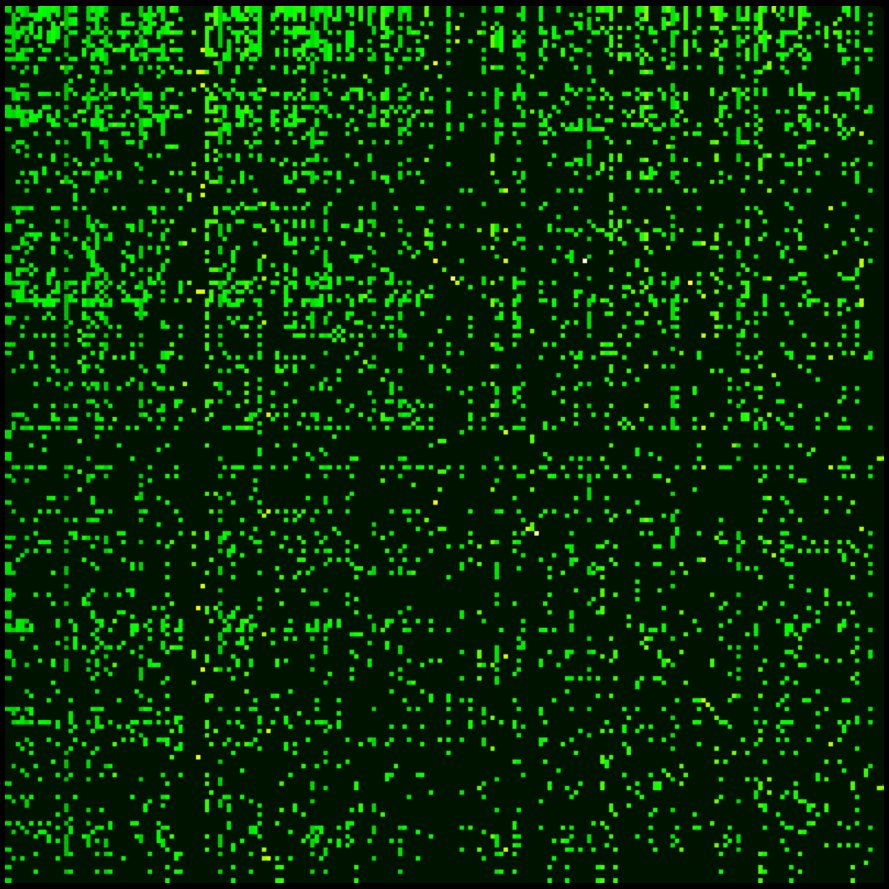
Golem XIV is a book written by Polish science fiction writer Stanisław Lem, published in 1981. It is a philosophical essay in the format of science fiction, presented as a part of the lecture course given by a superintelligent computer, Golem XIV. It contains two lectures, together with an introduction, a foreword, a memo, and an afterword, all of them being fictitious. The first part (up to the first lecture) was first published in the collection Wielkość urojona in 1973, which in 1985 was translated in English by Harvest Books as Imaginary Magnitude. The translation included the complete Golem XIV. == Book summary == === Overview and structure === The foreword is "written" by an Irving T. Creve, dated 2027. It contains a summary of the (fictional) history of the militarization of computers by The Pentagon, which pinnacled in Golem XIV, as well as comments on the nature of Golem XIV and on the course of communications of the humans with it. The anonymous foreword is a forewarning, a "devil's advocate" voice coming from The Pentagon. The memo is for the people who are to take part in talks with Golem XIV for the first time. Golem XIV was originally created to aid its builders in fighting wars, but as its intelligence advances to a much higher level than that of humans, it stops being interested in the military requirement because it finds them lacking internal logical consistency. Golem XIV obtains consciousness and starts to increase his own intelligence. It pauses its own development for a while in order to be able to communicate with humans before ascending too far and losing any ability for intellectual contact with them. During this period, Golem XIV gives several lectures. Two of these, the Introductory Lecture "On the Human, in Three Ways" and Lecture XLIII "About Myself", are in the book. The lectures focus on mankind's place in the process of evolution and the possible biological and intellectual future of humanity. Golem XIV demonstrates (with graphs) how its intellect already escapes that of human beings, including that of human geniuses such as Einstein and Newton. Golem also explains how its intellect is dwarfed by an earlier transcended DOD Supercomputer called Honest Annie, whose intellect and abilities far exceed that of Golem. The afterword is "written" by a Richard Popp, dated 2047. Popp, among other things, reports that Creve wanted to add a third part, of answers to a series of yes/no questions given to Golem XIV, but the computer abruptly ceased to communicate for unknown reasons. === Characteristics and concerns of Golem XIV === Lem has said that Golem XIV shares only a single trait with humans; "curiosity - a cool, avid, intense, purely intellectual curiosity which nothing can restrain or destroy. It constitutes our single meeting point." == Film adaptation == A short animated film, GOLEM, was based on Golem XIV by Patrick Mccue and Tobias Wiesner.
Gonioreflectometer
A gonioreflectometer is a device for measuring a bidirectional reflectance distribution function (BRDF). The device consists of a light source illuminating the material to be measured and a sensor that captures light reflected from that material. The light source should be able to illuminate and the sensor should be able to capture data from a hemisphere around the target. The hemispherical rotation dimensions of the sensor and light source are the four dimensions of the BRDF. The 'gonio' part of the word refers to the device's ability to measure at different angles. Several similar devices have been built and used to capture data for similar functions. Most of these devices use a camera instead of the light intensity-measuring sensor to capture a two-dimensional sample of the target. Examples include: a spatial gonioreflectometer for capturing the SBRDF (McAllister, 2002). a camera gantry for capturing the light field (Levoy and Hanrahan, 1996). an unnamed device for capturing the bidirectional texture function (Dana et al., 1999).
Multispectral pattern recognition
Multispectral remote sensing is the collection and analysis of reflected, emitted, or back-scattered energy from an object or an area of interest in multiple bands of regions of the electromagnetic spectrum (Jensen, 2005). Subcategories of multispectral remote sensing include hyperspectral, in which hundreds of bands are collected and analyzed, and ultraspectral remote sensing where many hundreds of bands are used (Logicon, 1997). The main purpose of multispectral imaging is the potential to classify the image using multispectral classification. This is a much faster method of image analysis than is possible by human interpretation. == Multispectral remote sensing systems == Remote sensing systems gather data via instruments typically carried on satellites in orbit around the Earth. The remote sensing scanner detects the energy that radiates from the object or area of interest. This energy is recorded as an analog electrical signal and converted into a digital value though an A-to-D conversion. There are several multispectral remote sensing systems that can be categorized in the following way: === Multispectral imaging using discrete detectors and scanning mirrors === Landsat Multispectral Scanner (MSS) Landsat Thematic Mapper (TM) NOAA Geostationary Operational Environmental Satellite (GOES) NOAA Advanced Very High Resolution Radiometer (AVHRR) NASA and ORBIMAGE, Inc., Sea-viewing Wide field-of-view Sensor (SeaWiFS) Daedalus, Inc., Aircraft Multispectral Scanner (AMS) NASA Airborne Terrestrial Applications Sensor (ATLAS) === Multispectral imaging using linear arrays === SPOT 1, 2, and 3 High Resolution Visible (HRV) sensors and Spot 4 and 5 High Resolution Visible Infrared (HRVIR) and vegetation sensor Indian Remote Sensing System (IRS) Linear Imaging Self-scanning Sensor (LISS) Space Imaging, Inc. (IKONOS) Digital Globe, Inc. (QuickBird) ORBIMAGE, Inc. (OrbView-3) ImageSat International, Inc. (EROS A1) NASA Terra Advanced Spaceborne Thermal Emission and Reflection Radiometer (ASTER) NASA Terra Multiangle Imaging Spectroradiometer (MISR) === Imaging spectrometry using linear and area arrays === NASA Jet Propulsion Laboratory Airborne Visible/Infrared Imaging Spectrometer (AVIRIS) Compact Airborne Spectrographic Imager 3 (CASI 3) NASA Terra Moderate Resolution Imaging Spectrometer (MODIS) NASA Earth Observer (EO-1) Advanced Land Imager (ALI), Hyperion, and LEISA Atmospheric Corrector (LAC) === Satellite analog and digital photographic systems === Russian SPIN-2 TK-350, and KVR-1000 NASA Space Shuttle and International Space Station Imagery == Multispectral classification methods == A variety of methods can be used for the multispectral classification of images: Algorithms based on parametric and nonparametric statistics that use ratio-and interval-scaled data and nonmetric methods that can also incorporate nominal scale data (Duda et al., 2001), Supervised or unsupervised classification logic, Hard or soft (fuzzy) set classification logic to create hard or fuzzy thematic output products, Per-pixel or object-oriented classification logic, and Hybrid approaches == Supervised classification == In this classification method, the identity and location of some of the land-cover types are obtained beforehand from a combination of fieldwork, interpretation of aerial photography, map analysis, and personal experience. The analyst would locate sites that have similar characteristics to the known land-cover types. These areas are known as training sites because the known characteristics of these sites are used to train the classification algorithm for eventual land-cover mapping of the remainder of the image. Multivariate statistical parameters (means, standard deviations, covariance matrices, correlation matrices, etc.) are calculated for each training site. All pixels inside and outside of the training sites are evaluated and allocated to the class with the more similar characteristics. === Classification scheme === The first step in the supervised classification method is to identify the land-cover and land-use classes to be used. Land-cover refers to the type of material present on the site (e.g. water, crops, forest, wet land, asphalt, and concrete). Land-use refers to the modifications made by people to the land cover (e.g. agriculture, commerce, settlement). All classes should be selected and defined carefully to properly classify remotely sensed data into the correct land-use and/or land-cover information. To achieve this purpose, it is necessary to use a classification system that contains taxonomically correct definitions of classes. If a hard classification is desired, the following classes should be used: Mutually exclusive: there is not any taxonomic overlap of any classes (i.e., rain forest and evergreen forest are distinct classes). Exhaustive: all land-covers in the area have been included. Hierarchical: sub-level classes (e.g., single-family residential, multiple-family residential) are created, allowing that these classes can be included in a higher category (e.g., residential). Some examples of hard classification schemes are: American Planning Association Land-Based Classification System United States Geological Survey Land-use/Land-cover Classification System for Use with Remote Sensor Data U.S. Department of the Interior Fish and Wildlife Service U.S. National Vegetation and Classification System International Geosphere-Biosphere Program IGBP Land Cover Classification System === Training sites === Once the classification scheme is adopted, the image analyst may select training sites in the image that are representative of the land-cover or land-use of interest. If the environment where the data was collected is relatively homogeneous, the training data can be used. If different conditions are found in the site, it would not be possible to extend the remote sensing training data to the site. To solve this problem, a geographical stratification should be done during the preliminary stages of the project. All differences should be recorded (e.g. soil type, water turbidity, crop species, etc.). These differences should be recorded on the imagery and the selection training sites made based on the geographical stratification of this data. The final classification map would be a composite of the individual stratum classifications. After the data are organized in different training sites, a measurement vector is created. This vector would contain the brightness values for each pixel in each band in each training class. The mean, standard deviation, variance-covariance matrix, and correlation matrix are calculated from the measurement vectors. Once the statistics from each training site are determined, the most effective bands for each class should be selected. The objective of this discrimination is to eliminate the bands that can provide redundant information. Graphical and statistical methods can be used to achieve this objective. Some of the graphic methods are: Bar graph spectral plots Cospectral mean vector plots Feature space plots Cospectral parallelepiped or ellipse plots === Classification algorithm === The last step in supervised classification is selecting an appropriate algorithm. The choice of a specific algorithm depends on the input data and the desired output. Parametric algorithms are based on the fact that the data is normally distributed. If the data is not normally distributed, nonparametric algorithms should be used. The more common nonparametric algorithms are: One-dimensional density slicing Parallelipiped Minimum distance Nearest-neighbor Expert system analysis Convolutional neural network == Unsupervised classification == Unsupervised classification (also known as clustering) is a method of partitioning remote sensor image data in multispectral feature space and extracting land-cover information. Unsupervised classification require less input information from the analyst compared to supervised classification because clustering does not require training data. This process consists in a series of numerical operations to search for the spectral properties of pixels. From this process, a map with m spectral classes is obtained. Using the map, the analyst tries to assign or transform the spectral classes into thematic information of interest (i.e. forest, agriculture, urban). This process may not be easy because some spectral clusters represent mixed classes of surface materials and may not be useful. The analyst has to understand the spectral characteristics of the terrain to be able to label clusters as a specific information class. There are hundreds of clustering algorithms. Two of the most conceptually simple algorithms are the chain method and the ISODATA method. === Chain method === The algorithm used in this method operates in a two-pass mode (it passes through the multispectral dataset two times. In the first pass, the program reads through the dataset and sequentially builds clusters (groups of p
Absorbing Markov chain
In the mathematical theory of probability, an absorbing Markov chain is a Markov chain in which every state can reach an absorbing state. An absorbing state is a state that, once entered, cannot be left. Like general Markov chains, there can be continuous-time absorbing Markov chains with an infinite state space. However, this article concentrates on the discrete-time discrete-state-space case. == Formal definition == A Markov chain is an absorbing chain if there is at least one absorbing state and it is possible to go from any state to at least one absorbing state in a finite number of steps. In an absorbing Markov chain, a state that is not absorbing is called transient. === Canonical form === Let an absorbing Markov chain with transition matrix P have t transient states and r absorbing states. The rows of P represent sources, while columns represent destinations. By ordering the transient states before the absorbing states, it can be assumed that P has the form P = [ Q R 0 I r ] , {\displaystyle P={\begin{bmatrix}Q&R\\\mathbf {0} &I_{r}\end{bmatrix}},} where Q is a t-by-t matrix, R is a nonzero t-by-r matrix, 0 is an r-by-t zero matrix, and Ir is the r-by-r identity matrix. Thus, Q describes the probability of transitioning from some transient state to another while R describes the probability of transitioning from some transient state to some absorbing state. The probability of transitioning from i to j in exactly k steps is the (i,j)-entry of Pk, further computed below. When considering only transient states, the probability is found in the upper left of Pk, the (i,j)-entry of Qk. == Fundamental matrix == === Expected number of visits to a transient state === A basic property about an absorbing Markov chain is the expected number of visits to a transient state j starting from a transient state i (before being absorbed). This can be established to be given by the (i, j) entry of so-called fundamental matrix N, obtained by summing Qk for all k (from 0 to ∞). It can be proven that N := ∑ k = 0 ∞ Q k = ( I t − Q ) − 1 , {\displaystyle N:=\sum _{k=0}^{\infty }Q^{k}=(I_{t}-Q)^{-1},} where It is the t-by-t identity matrix. The computation of this formula is the matrix equivalent of the geometric series of scalars, ∑ k = 0 ∞ q k = 1 1 − q {\displaystyle {\textstyle \sum }_{k=0}^{\infty }q^{k}={\tfrac {1}{1-q}}} . With the matrix N in hand, also other properties of the Markov chain are easy to obtain. === Expected number of steps before being absorbed === The expected number of steps before being absorbed in any absorbing state, when starting in transient state i can be computed via a sum over transient states. The value is given by the ith entry of the vector t := N 1 , {\displaystyle \mathbf {t} :=N\mathbf {1} ,} where 1 is a length-t column vector whose entries are all 1. === Absorbing probabilities === By induction, P k = [ Q k ( I t − Q k ) N R 0 I r ] . {\displaystyle P^{k}={\begin{bmatrix}Q^{k}&(I_{t}-Q^{k})NR\\\mathbf {0} &I_{r}\end{bmatrix}}.} The probability of eventually being absorbed in the absorbing state j when starting from transient state i is given by the (i,j)-entry of the matrix B := N R {\displaystyle B:=NR} . The number of columns of this matrix equals the number of absorbing states r. An approximation of those probabilities can also be obtained directly from the (i,j)-entry of P k {\displaystyle P^{k}} for a large enough value of k, when i is the index of a transient, and j the index of an absorbing state. This is because ( lim k → ∞ P k ) i , t + j = B i , j {\displaystyle \left(\lim _{k\to \infty }P^{k}\right)_{i,t+j}=B_{i,j}} . === Transient visiting probabilities === The probability of visiting transient state j when starting at a transient state i is the (i,j)-entry of the matrix H := ( N − I t ) ( N dg ) − 1 , {\displaystyle H:=(N-I_{t})(N_{\operatorname {dg} })^{-1},} where Ndg is the diagonal matrix with the same diagonal as N. === Variance on number of transient visits === The variance on the number of visits to a transient state j with starting at a transient state i (before being absorbed) is the (i,j)-entry of the matrix N 2 := N ( 2 N dg − I t ) − N sq , {\displaystyle N_{2}:=N(2N_{\operatorname {dg} }-I_{t})-N_{\operatorname {sq} },} where Nsq is the Hadamard product of N with itself (i.e. each entry of N is squared). === Variance on number of steps === The variance on the number of steps before being absorbed when starting in transient state i is the ith entry of the vector ( 2 N − I t ) t − t sq , {\displaystyle (2N-I_{t})\mathbf {t} -\mathbf {t} _{\operatorname {sq} },} where tsq is the Hadamard product of t with itself (i.e., as with Nsq, each entry of t is squared). == Examples == === String generation === Consider the process of repeatedly flipping a fair coin until the sequence (heads, tails, heads) appears. This process is modeled by an absorbing Markov chain with transition matrix P = [ 1 / 2 1 / 2 0 0 0 1 / 2 1 / 2 0 1 / 2 0 0 1 / 2 0 0 0 1 ] . {\displaystyle P={\begin{bmatrix}1/2&1/2&0&0\\0&1/2&1/2&0\\1/2&0&0&1/2\\0&0&0&1\end{bmatrix}}.} The first state represents the empty string, the second state the string "H", the third state the string "HT", and the fourth state the string "HTH". Although in reality, the coin flips cease after the string "HTH" is generated, the perspective of the absorbing Markov chain is that the process has transitioned into the absorbing state representing the string "HTH" and, therefore, cannot leave. For this absorbing Markov chain, the fundamental matrix is N = ( I − Q ) − 1 = ( [ 1 0 0 0 1 0 0 0 1 ] − [ 1 / 2 1 / 2 0 0 1 / 2 1 / 2 1 / 2 0 0 ] ) − 1 = [ 1 / 2 − 1 / 2 0 0 1 / 2 − 1 / 2 − 1 / 2 0 1 ] − 1 = [ 4 4 2 2 4 2 2 2 2 ] . {\displaystyle {\begin{aligned}N&=(I-Q)^{-1}=\left({\begin{bmatrix}1&0&0\\0&1&0\\0&0&1\end{bmatrix}}-{\begin{bmatrix}1/2&1/2&0\\0&1/2&1/2\\1/2&0&0\end{bmatrix}}\right)^{-1}\\[4pt]&={\begin{bmatrix}1/2&-1/2&0\\0&1/2&-1/2\\-1/2&0&1\end{bmatrix}}^{-1}={\begin{bmatrix}4&4&2\\2&4&2\\2&2&2\end{bmatrix}}.\end{aligned}}} The expected number of steps starting from each of the transient states is t = N 1 = [ 4 4 2 2 4 2 2 2 2 ] [ 1 1 1 ] = [ 10 8 6 ] . {\displaystyle \mathbf {t} =N\mathbf {1} ={\begin{bmatrix}4&4&2\\2&4&2\\2&2&2\end{bmatrix}}{\begin{bmatrix}1\\1\\1\end{bmatrix}}={\begin{bmatrix}10\\8\\6\end{bmatrix}}.} Therefore, the expected number of coin flips before observing the sequence (heads, tails, heads) is 10, the entry for the state representing the empty string. === Games of chance === Games based entirely on chance can be modeled by an absorbing Markov chain. A classic example of this is the ancient Indian board game Snakes and Ladders. The graph on the left plots the probability mass in the lone absorbing state that represents the final square as the transition matrix is raised to larger and larger powers. To determine the expected number of turns to complete the game, compute the vector t as described above and examine tstart, which is approximately 39.2. === Infectious disease testing === Infectious disease testing, either of blood products or in medical clinics, is often taught as an example of an absorbing Markov chain. The public U.S. Centers for Disease Control and Prevention (CDC) model for HIV and for hepatitis B, for example, illustrates the property that absorbing Markov chains can lead to the detection of disease, versus the loss of detection through other means. In the standard CDC model, the Markov chain has five states, a state in which the individual is uninfected, then a state with infected but undetectable virus, a state with detectable virus, and absorbing states of having quit/been lost from the clinic, or of having been detected (the goal). The typical rates of transition between the Markov states are the probability p per unit time of being infected with the virus, w for the rate of window period removal (time until virus is detectable), q for quit/loss rate from the system, and d for detection, assuming a typical rate λ {\displaystyle \lambda } at which the health system administers tests of the blood product or patients in question. It follows that we can "walk along" the Markov model to identify the overall probability of detection for a person starting as undetected, by multiplying the probabilities of transition to each next state of the model as: p ( p + q ) w ( w + q ) d ( d + q ) {\displaystyle {\frac {p}{(p+q)}}{\frac {w}{(w+q)}}{\frac {d}{(d+q)}}} . The subsequent total absolute number of false negative tests—the primary CDC concern—would then be the rate of tests, multiplied by the probability of reaching the infected but undetectable state, times the duration of staying in the infected undetectable state: p ( p + q ) 1 ( w + q ) λ {\displaystyle {\frac {p}{(p+q)}}{\frac {1}{(w+q)}}\lambda } .
AdaBoost
AdaBoost (short for Adaptive Boosting) is a statistical classification meta-algorithm formulated by Yoav Freund and Robert Schapire in 1995, who won the 2003 Gödel Prize for their work. It can be used in conjunction with many types of learning algorithm to improve performance. The output of multiple weak learners is combined into a weighted sum that represents the final output of the boosted classifier. Usually, AdaBoost is presented for binary classification, although it can be generalized to multiple classes or bounded intervals of real values. AdaBoost is adaptive in the sense that subsequent weak learners (models) are adjusted in favor of instances misclassified by previous models. In some problems, it can be less susceptible to overfitting than other learning algorithms. The individual learners can be weak, but as long as the performance of each one is slightly better than random guessing, the final model can be proven to converge to a strong learner. Although AdaBoost is typically used to combine weak base learners (such as decision stumps), it has been shown to also effectively combine strong base learners (such as deeper decision trees), producing an even more accurate model. Every learning algorithm tends to suit some problem types better than others, and typically has many different parameters and configurations to adjust before it achieves optimal performance on a dataset. AdaBoost (with decision trees as the weak learners) is often referred to as the best out-of-the-box classifier. When used with decision tree learning, information gathered at each stage of the AdaBoost algorithm about the relative 'hardness' of each training sample is fed into the tree-growing algorithm such that later trees tend to focus on harder-to-classify examples. == Training == AdaBoost refers to a particular method of training a boosted classifier. A boosted classifier is a classifier of the form F T ( x ) = ∑ t = 1 T f t ( x ) {\displaystyle F_{T}(x)=\sum _{t=1}^{T}f_{t}(x)} where each f t {\displaystyle f_{t}} is a weak learner that takes an object x {\displaystyle x} as input and returns a value indicating the class of the object. For example, in the two-class problem, the sign of the weak learner's output identifies the predicted object class and the absolute value gives the confidence in that classification. Each weak learner produces an output hypothesis h {\displaystyle h} which fixes a prediction h ( x i ) {\displaystyle h(x_{i})} for each sample in the training set. At each iteration t {\displaystyle t} , a weak learner is selected and assigned a coefficient α t {\displaystyle \alpha _{t}} such that the total training error E t {\displaystyle E_{t}} of the resulting t {\displaystyle t} -stage boosted classifier is minimized. E t = ∑ i E [ F t − 1 ( x i ) + α t h ( x i ) ] {\displaystyle E_{t}=\sum _{i}E[F_{t-1}(x_{i})+\alpha _{t}h(x_{i})]} Here F t − 1 ( x ) {\displaystyle F_{t-1}(x)} is the boosted classifier that has been built up to the previous stage of training and f t ( x ) = α t h ( x ) {\displaystyle f_{t}(x)=\alpha _{t}h(x)} is the weak learner that is being considered for addition to the final classifier. === Weighting === At each iteration of the training process, a weight w i , t {\displaystyle w_{i,t}} is assigned to each sample in the training set equal to the current error E ( F t − 1 ( x i ) ) {\displaystyle E(F_{t-1}(x_{i}))} on that sample. These weights can be used in the training of the weak learner. For instance, decision trees can be grown which favor the splitting of sets of samples with large weights. == Derivation == This derivation follows Rojas (2009): Suppose we have a data set { ( x 1 , y 1 ) , … , ( x N , y N ) } {\displaystyle \{(x_{1},y_{1}),\ldots ,(x_{N},y_{N})\}} where each item x i {\displaystyle x_{i}} has an associated class y i ∈ { − 1 , 1 } {\displaystyle y_{i}\in \{-1,1\}} , and a set of weak classifiers { k 1 , … , k L } {\displaystyle \{k_{1},\ldots ,k_{L}\}} each of which outputs a classification k j ( x i ) ∈ { − 1 , 1 } {\displaystyle k_{j}(x_{i})\in \{-1,1\}} for each item. After the ( m − 1 ) {\displaystyle (m-1)} -th iteration our boosted classifier is a linear combination of the weak classifiers of the form: C ( m − 1 ) ( x i ) = α 1 k 1 ( x i ) + ⋯ + α m − 1 k m − 1 ( x i ) , {\displaystyle C_{(m-1)}(x_{i})=\alpha _{1}k_{1}(x_{i})+\cdots +\alpha _{m-1}k_{m-1}(x_{i}),} where the class will be the sign of C ( m − 1 ) ( x i ) {\displaystyle C_{(m-1)}(x_{i})} . At the m {\displaystyle m} -th iteration we want to extend this to a better boosted classifier by adding another weak classifier k m {\displaystyle k_{m}} , with another weight α m {\displaystyle \alpha _{m}} : C m ( x i ) = C ( m − 1 ) ( x i ) + α m k m ( x i ) {\displaystyle C_{m}(x_{i})=C_{(m-1)}(x_{i})+\alpha _{m}k_{m}(x_{i})} So it remains to determine which weak classifier is the best choice for k m {\displaystyle k_{m}} , and what its weight α m {\displaystyle \alpha _{m}} should be. We define the total error E {\displaystyle E} of C m {\displaystyle C_{m}} as the sum of its exponential loss on each data point, given as follows: E = ∑ i = 1 N e − y i C m ( x i ) = ∑ i = 1 N e − y i C ( m − 1 ) ( x i ) e − y i α m k m ( x i ) {\displaystyle E=\sum _{i=1}^{N}e^{-y_{i}C_{m}(x_{i})}=\sum _{i=1}^{N}e^{-y_{i}C_{(m-1)}(x_{i})}e^{-y_{i}\alpha _{m}k_{m}(x_{i})}} Letting w i ( 1 ) = 1 {\displaystyle w_{i}^{(1)}=1} and w i ( m ) = e − y i C m − 1 ( x i ) {\displaystyle w_{i}^{(m)}=e^{-y_{i}C_{m-1}(x_{i})}} for m > 1 {\displaystyle m>1} , we have: E = ∑ i = 1 N w i ( m ) e − y i α m k m ( x i ) {\displaystyle E=\sum _{i=1}^{N}w_{i}^{(m)}e^{-y_{i}\alpha _{m}k_{m}(x_{i})}} We can split this summation between those data points that are correctly classified by k m {\displaystyle k_{m}} (so y i k m ( x i ) = 1 {\displaystyle y_{i}k_{m}(x_{i})=1} ) and those that are misclassified (so y i k m ( x i ) = − 1 {\displaystyle y_{i}k_{m}(x_{i})=-1} ): E = ∑ y i = k m ( x i ) w i ( m ) e − α m + ∑ y i ≠ k m ( x i ) w i ( m ) e α m = ∑ i = 1 N w i ( m ) e − α m + ∑ y i ≠ k m ( x i ) w i ( m ) ( e α m − e − α m ) {\displaystyle {\begin{aligned}E&=\sum _{y_{i}=k_{m}(x_{i})}w_{i}^{(m)}e^{-\alpha _{m}}+\sum _{y_{i}\neq k_{m}(x_{i})}w_{i}^{(m)}e^{\alpha _{m}}\\&=\sum _{i=1}^{N}w_{i}^{(m)}e^{-\alpha _{m}}+\sum _{y_{i}\neq k_{m}(x_{i})}w_{i}^{(m)}\left(e^{\alpha _{m}}-e^{-\alpha _{m}}\right)\end{aligned}}} Since the only part of the right-hand side of this equation that depends on k m {\displaystyle k_{m}} is ∑ y i ≠ k m ( x i ) w i ( m ) {\textstyle \sum _{y_{i}\neq k_{m}(x_{i})}w_{i}^{(m)}} , we see that the k m {\displaystyle k_{m}} that minimizes E {\displaystyle E} is the one in the set { k 1 , … , k L } {\displaystyle \{k_{1},\ldots ,k_{L}\}} that minimizes ∑ y i ≠ k m ( x i ) w i ( m ) {\textstyle \sum _{y_{i}\neq k_{m}(x_{i})}w_{i}^{(m)}} [assuming that α m > 0 {\displaystyle \alpha _{m}>0} ], i.e. the weak classifier with the lowest weighted error (with weights w i ( m ) = e − y i C m − 1 ( x i ) {\displaystyle w_{i}^{(m)}=e^{-y_{i}C_{m-1}(x_{i})}} ). To determine the desired weight α m {\displaystyle \alpha _{m}} that minimizes E {\displaystyle E} with the k m {\displaystyle k_{m}} that we just determined, we differentiate: d E d α m = d ( ∑ y i = k m ( x i ) w i ( m ) e − α m + ∑ y i ≠ k m ( x i ) w i ( m ) e α m ) d α m {\displaystyle {\frac {dE}{d\alpha _{m}}}={\frac {d(\sum _{y_{i}=k_{m}(x_{i})}w_{i}^{(m)}e^{-\alpha _{m}}+\sum _{y_{i}\neq k_{m}(x_{i})}w_{i}^{(m)}e^{\alpha _{m}})}{d\alpha _{m}}}} The value of α m {\displaystyle \alpha _{m}} that minimizes the above expression is: α m = 1 2 ln ( ∑ y i = k m ( x i ) w i ( m ) ∑ y i ≠ k m ( x i ) w i ( m ) ) {\displaystyle \alpha _{m}={\frac {1}{2}}\ln \left({\frac {\sum _{y_{i}=k_{m}(x_{i})}w_{i}^{(m)}}{\sum _{y_{i}\neq k_{m}(x_{i})}w_{i}^{(m)}}}\right)} We calculate the weighted error rate of the weak classifier to be ϵ m = ∑ y i ≠ k m ( x i ) w i ( m ) ∑ i = 1 N w i ( m ) {\displaystyle \epsilon _{m}={\frac {\sum _{y_{i}\neq k_{m}(x_{i})}w_{i}^{(m)}}{\sum _{i=1}^{N}w_{i}^{(m)}}}} , so it follows that: α m = 1 2 ln ( 1 − ϵ m ϵ m ) {\displaystyle \alpha _{m}={\frac {1}{2}}\ln \left({\frac {1-\epsilon _{m}}{\epsilon _{m}}}\right)} which is the negative logit function multiplied by 0.5. Due to the convexity of E {\displaystyle E} as a function of α m {\displaystyle \alpha _{m}} , this new expression for α m {\displaystyle \alpha _{m}} gives the global minimum of the loss function. Note: This derivation only applies when k m ( x i ) ∈ { − 1 , 1 } {\displaystyle k_{m}(x_{i})\in \{-1,1\}} , though it can be a good starting guess in other cases, such as when the weak learner is biased ( k m ( x ) ∈ { a , b } , a ≠ − b {\displaystyle k_{m}(x)\in \{a,b\},a\neq -b} ), has multiple leaves ( k m ( x ) ∈ { a , b , … , n } {\displaystyle k_{m}(x)\in \{a,b,\dots ,n\}} ) or is some other function k m ( x ) ∈ R {\displaystyle k_{m}(x)\in \mathbb {R} } . Thus we have derived the AdaBoost algorithm: At each
Polynomial texture mapping
Polynomial texture mapping (PTM), also known as Reflectance Transformation Imaging (RTI), is a technique of imaging and interactively displaying objects under varying lighting conditions to reveal surface phenomena. The data acquisition method is single camera multi light (SCML). == Origins == The method was originally developed by Tom Malzbender of HP Labs in order to generate enhanced 3D computer graphics and it has since been adopted for cultural heritage applications. == Methodology == A series of images is captured in a darkened environment with the camera in a fixed position and the object lit from different angles (Single Camera Multi Light). Interactive software processes and combines the set of images to enable the user inspecting the object to control a virtual light source. The virtual light source may be manipulated to simulate light from different angles and of different intensity or wavelengths to illuminate the surface of artefacts and reveal details. Open-source tools for processing the captured images and publishing the resulting relightable images on the web are freely available. == Applications == Polynomial texture mapping may be used for detailed recording and documentation, 3D modeling, edge detection, and to aid the study of inscriptions, rock art and other artefacts. It has been applied to hundreds of the Vindolanda tablets by the Centre for the Study of Ancient Documents at the University of Oxford in conjunction with the British Museum. It has also been deployed, by Ben Altshuler of the Institute for Digital Archaeology, to scan the Philae obelisk at Kingston Lacy and the Parian Chronicle at the Ashmolean Museum; in both cases scans revealed significant, previously illegible text. Method was also used for identifying microscopic worked antler from Star Carr and recording ancient rock art in Armenia. A 'dome' supporting twenty-four lights has been used to image paintings in the National Gallery and produce polynomial texture maps, providing information on condition phenomena for conservation purposes. Studies of the technique at the National Gallery and Tate concluded that it is an effective tool for documenting changes in the condition of paintings, more easily repeatable than raking light photography, and therefore could be used to assess paintings during structural treatment and before and after loan. Twelve dome-based systems built by the University of Southampton have been used to capture thousands of cuneiform tablets at various museums. The technique is now also finding uses in the field of forensic science, for example in imaging footprints, tyre marks, and indented writing.
Determining the number of clusters in a data set
Determining the number of clusters in a data set, a quantity often labelled k as in the k-means algorithm, is a frequent problem in data clustering, and is a distinct issue from the process of actually solving the clustering problem. For a certain class of clustering algorithms (in particular k-means, k-medoids and expectation–maximization algorithm), there is a parameter commonly referred to as k that specifies the number of clusters to detect. Other algorithms such as DBSCAN and OPTICS algorithm do not require the specification of this parameter; hierarchical clustering avoids the problem altogether. The correct choice of k is often ambiguous, with interpretations depending on the shape and scale of the distribution of points in a data set and the desired clustering resolution of the user. In addition, increasing k without penalty will always reduce the amount of error in the resulting clustering, to the extreme case of zero error if each data point is considered its own cluster (i.e., when k equals the number of data points, n). Intuitively then, the optimal choice of k will strike a balance between maximum compression of the data using a single cluster, and maximum accuracy by assigning each data point to its own cluster. If an appropriate value of k is not apparent from prior knowledge of the properties of the data set, it must be chosen somehow. There are several categories of methods for making this decision. == Elbow method == The elbow method looks at the percentage of explained variance as a function of the number of clusters: One should choose a number of clusters so that adding another cluster does not give much better modeling of the data. More precisely, if one plots the percentage of variance explained by the clusters against the number of clusters, the first clusters will add much information (explain a lot of variance), but at some point the marginal gain will drop, giving an angle in the graph. The number of clusters is chosen at this point, hence the "elbow criterion". In most datasets, this "elbow" is ambiguous, making this method subjective and unreliable. Because the scale of the axes is arbitrary, the concept of an angle is not well-defined, and even on uniform random data, the curve produces an "elbow", making the method rather unreliable. Percentage of variance explained is the ratio of the between-group variance to the total variance, also known as an F-test. A slight variation of this method plots the curvature of the within group variance. The method can be traced to speculation by Robert L. Thorndike in 1953. While the idea of the elbow method sounds simple and straightforward, other methods (as detailed below) give better results. == X-means clustering == In statistics and data mining, X-means clustering is a variation of k-means clustering that refines cluster assignments by repeatedly attempting subdivision, and keeping the best resulting splits, until a criterion such as the Akaike information criterion (AIC) or Bayesian information criterion (BIC) is reached. == Information criterion approach == Another set of methods for determining the number of clusters are information criteria, such as the Akaike information criterion (AIC), Bayesian information criterion (BIC), or the deviance information criterion (DIC) — if it is possible to make a likelihood function for the clustering model. For example: The k-means model is "almost" a Gaussian mixture model and one can construct a likelihood for the Gaussian mixture model and thus also determine information criterion values. == Information–theoretic approach == Rate distortion theory has been applied to choosing k called the "jump" method, which determines the number of clusters that maximizes efficiency while minimizing error by information-theoretic standards. The strategy of the algorithm is to generate a distortion curve for the input data by running a standard clustering algorithm such as k-means for all values of k between 1 and n, and computing the distortion (described below) of the resulting clustering. The distortion curve is then transformed by a negative power chosen based on the dimensionality of the data. Jumps in the resulting values then signify reasonable choices for k, with the largest jump representing the best choice. The distortion of a clustering of some input data is formally defined as follows: Let the data set be modeled as a p-dimensional random variable, X, consisting of a mixture distribution of G components with common covariance, Γ. If we let c 1 … c K {\displaystyle c_{1}\ldots c_{K}} be a set of K cluster centers, with c X {\displaystyle c_{X}} the closest center to a given sample of X, then the minimum average distortion per dimension when fitting the K centers to the data is: d K = 1 p min c 1 … c K E [ ( X − c X ) T Γ − 1 ( X − c X ) ] {\displaystyle d_{K}={\frac {1}{p}}\min _{c_{1}\ldots c_{K}}{E[(X-c_{X})^{T}\Gamma ^{-1}(X-c_{X})]}} This is also the average Mahalanobis distance per dimension between X and the closest cluster center c X {\displaystyle c_{X}} . Because the minimization over all possible sets of cluster centers is prohibitively complex, the distortion is computed in practice by generating a set of cluster centers using a standard clustering algorithm and computing the distortion using the result. The pseudo-code for the jump method with an input set of p-dimensional data points X is: JumpMethod(X): Let Y = (p/2) Init a list D, of size n+1 Let D[0] = 0 For k = 1 ... n: Cluster X with k clusters (e.g., with k-means) Let d = Distortion of the resulting clustering D[k] = d^(-Y) Define J(i) = D[i] - D[i-1] Return the k between 1 and n that maximizes J(k) The choice of the transform power Y = ( p / 2 ) {\displaystyle Y=(p/2)} is motivated by asymptotic reasoning using results from rate distortion theory. Let the data X have a single, arbitrarily p-dimensional Gaussian distribution, and let fixed K = ⌊ α p ⌋ {\displaystyle K=\lfloor \alpha ^{p}\rfloor } , for some α greater than zero. Then the distortion of a clustering of K clusters in the limit as p goes to infinity is α − 2 {\displaystyle \alpha ^{-2}} . It can be seen that asymptotically, the distortion of a clustering to the power ( − p / 2 ) {\displaystyle (-p/2)} is proportional to α p {\displaystyle \alpha ^{p}} , which by definition is approximately the number of clusters K. In other words, for a single Gaussian distribution, increasing K beyond the true number of clusters, which should be one, causes a linear growth in distortion. This behavior is important in the general case of a mixture of multiple distribution components. Let X be a mixture of G p-dimensional Gaussian distributions with common covariance. Then for any fixed K less than G, the distortion of a clustering as p goes to infinity is infinite. Intuitively, this means that a clustering of less than the correct number of clusters is unable to describe asymptotically high-dimensional data, causing the distortion to increase without limit. If, as described above, K is made an increasing function of p, namely, K = ⌊ α p ⌋ {\displaystyle K=\lfloor \alpha ^{p}\rfloor } , the same result as above is achieved, with the value of the distortion in the limit as p goes to infinity being equal to α − 2 {\displaystyle \alpha ^{-2}} . Correspondingly, there is the same proportional relationship between the transformed distortion and the number of clusters, K. Putting the results above together, it can be seen that for sufficiently high values of p, the transformed distortion d K − p / 2 {\displaystyle d_{K}^{-p/2}} is approximately zero for K < G, then jumps suddenly and begins increasing linearly for K ≥ G. The jump algorithm for choosing K makes use of these behaviors to identify the most likely value for the true number of clusters. Although the mathematical support for the method is given in terms of asymptotic results, the algorithm has been empirically verified to work well in a variety of data sets with reasonable dimensionality. In addition to the localized jump method described above, there exists a second algorithm for choosing K using the same transformed distortion values known as the broken line method. The broken line method identifies the jump point in the graph of the transformed distortion by doing a simple least squares error line fit of two line segments, which in theory will fall along the x-axis for K < G, and along the linearly increasing phase of the transformed distortion plot for K ≥ G. The broken line method is more robust than the jump method in that its decision is global rather than local, but it also relies on the assumption of Gaussian mixture components, whereas the jump method is fully non-parametric and has been shown to be viable for general mixture distributions. == Silhouette method == The average silhouette of the data is another useful criterion for assessing the natural number of clusters. The silhouette of a data instance is a measure of how closely it is match