In robotics and motion planning, kinodynamic planning is a class of problems for which velocity, acceleration, and force/torque bounds must be satisfied, together with kinematic constraints such as avoiding obstacles. The term was coined by Bruce Donald, Pat Xavier, John Canny, and John Reif. Donald et al. developed the first polynomial-time approximation schemes (PTAS) for the problem. By providing a provably polynomial-time ε-approximation algorithm, they resolved a long-standing open problem in optimal control. Their first paper considered time-optimal control ("fastest path") of a point mass under Newtonian dynamics, amidst polygonal (2D) or polyhedral (3D) obstacles, subject to state bounds on position, velocity, and acceleration. Later they extended the technique to many other cases, for example, to 3D open-chain kinematic robots under full Lagrangian dynamics. == Modern approaches == Since the foundational theoretical work of the 1990s, the field has evolved significantly with new algorithmic approaches that address the computational and practical limitations of early methods. === Sampling-based methods === Many practical heuristic algorithms based on stochastic optimization and iterative sampling have been developed by a wide range of authors to address the kinodynamic planning problem. Popular approaches include extensions of RRT algorithms such as RRT for kinodynamic systems, and sampling-based methods like Model Predictive Path Integral (MPPI) control. These stochastic techniques have been shown to work well in practice and can handle complex, high-dimensional state spaces more efficiently than deterministic methods. However, all motion planning methods are subject to the PSPACE-hardnesss of classical motion planning even without dynamics, which means (assuming the usual structural complexity conjectures) they all can be worst-case exponential-time in the state-space dimension (the number of degrees of freedom). On the other hand, the deterministic methods have provable guarantees of completeness, accuracy, and complexity (for fixed dimension, they are polynomial-time not only in the geometric complexity, but also in ( 1 / ε ) {\displaystyle (1/\varepsilon )} , the closeness of the desired approximation), whereas most of the recent heuristic/stochastic methods sacrifice at least one of these criteria. === Mixed-integer optimization approaches === Recent advances in mixed-integer programming have enabled new deterministic approaches to kinodynamic planning. These methods formulate the planning problem as an optimization task that simultaneously determines the spatial path and control sequence while respecting all kinodynamic constraints. By using techniques such as McCormick envelopes to handle bilinear constraints, these approaches can provide globally optimal solutions with mathematical guarantees while achieving significant computational speedups over traditional methods. === Genetic algorithm approaches === Genetic algorithms have also been adapted for kinodynamic planning, particularly for gradient-free optimization in challenging terrain. These methods use evolutionary computation to optimize trajectories over receding horizons, with specialized mutation operators that ensure vehicle controls remain within operational limits. This approach is particularly useful when dealing with non-differentiable cost functions or when gradient information is unavailable or unreliable. === Three-dimensional terrain planning === The foundational theoretical work of the 1990s was extended to higher degrees of freedom, and even to n {\displaystyle n} -link, 3D open-chain kinematic robots under full Lagrangian dynamics. However, many of the subsequent heuristic techniques (typically employing stochastic optimization) were confined to planar environments. More recent kinodynamic planning has extended beyond these planar environments to handle complex 3D terrains represented as simplicial complexes or triangular meshes. This advancement is particularly important for applications such as autonomous vehicle navigation in off-road environments, where elevation changes and terrain geometry significantly impact vehicle dynamics. These methods must account for pitch angles, surface curvature, and the coupling between terrain geometry and vehicle kinodynamic constraints. == Performance and guarantees == The landscape of performance guarantees in kinodynamic planning has evolved considerably. While early heuristic methods could not guarantee optimality, recent mixed-integer approaches have demonstrated the ability to find globally optimal solutions with proven constraint satisfaction. Experimental comparisons have shown that modern optimization-based planners can achieve execution times several orders of magnitude faster than sampling-based methods while maintaining strict adherence to kinodynamic constraints. However, the choice of method often depends on the specific application requirements. Sampling-based methods remain valuable for their ability to quickly find feasible solutions in high-dimensional spaces and their robustness to modeling uncertainties. Optimization-based methods excel when optimality guarantees and constraint compliance are critical, particularly in safety-critical applications. == Applications == Kinodynamic planning finds applications across numerous domains including: Autonomous vehicles: Path planning for cars, trucks, and other ground vehicles that must respect acceleration, steering, and velocity limits Aerial robotics: Trajectory planning for quadrotors and other unmanned aerial vehicles with dynamic constraints Manipulation: Planning for robotic arms where joint velocities, accelerations, and torques are limited Legged locomotion: Footstep and trajectory planning for walking and running robots Space robotics: Planning under thrust and fuel constraints for spacecraft and rovers
Color moments
Color moments are measures that characterise color distribution in an image in the same way that central moments uniquely describe a probability distribution. Color moments are mainly used for color indexing purposes as features in image retrieval applications in order to compare how similar two images are based on color. Usually one image is compared to a database of digital images with pre-computed features in order to find and retrieve a similar Image. Each comparison between images results in a similarity score, and the lower this score is the more identical the two images are supposed to be. == Overview == Color moments are scaling and rotation invariant. It is usually the case that only the first three color moments are used as features in image retrieval applications as most of the color distribution information is contained in the low-order moments. Since color moments encode both shape and color information they are a good feature to use under changing lighting conditions, but they cannot handle occlusion very successfully. Color moments can be computed for any color model. Three color moments are computed per channel (e.g. 9 moments if the color model is RGB and 12 moments if the color model is CMYK). Computing color moments is done in the same way as computing moments of a probability distribution. === Mean === The first color moment can be interpreted as the average color in the image, and it can be calculated by using the following formula E i = ∑ j = 1 N 1 N p i j {\displaystyle E_{i}=\textstyle \sum _{j=1}^{N}{\frac {1}{N}}p_{ij}} where N is the number of pixels in the image and p i j {\displaystyle p_{ij}} is the value of the j-th pixel of the image at the i-th color channel. === Standard Deviation === The second color moment is the standard deviation, which is obtained by taking the square root of the variance of the color distribution. σ i = ( 1 N ∑ j = 1 N ( p i j − E i ) 2 ) {\displaystyle \sigma _{i}={\sqrt {({\frac {1}{N}}\textstyle \sum _{j=1}^{N}(p_{ij}-E_{i})^{2})}}} where E i {\displaystyle E_{i}} is the mean value, or first color moment, for the i-th color channel of the image. === Skewness === The third color moment is the skewness. It measures how asymmetric the color distribution is, and thus it gives information about the shape of the color distribution. Skewness can be computed with the following formula: s i = ( 1 N ∑ j = 1 N ( p i j − E i ) 3 ) 3 σ i {\displaystyle s_{i}={\frac {\sqrt[{3}]{\left({\frac {1}{N}}\textstyle \sum _{j=1}^{N}(p_{ij}-E_{i})^{3}\right)}}{\sigma _{i}}}} === Kurtosis === Kurtosis is the fourth color moment, and, similarly to skewness, it provides information about the shape of the color distribution. More specifically, kurtosis is a measure of how extreme the tails are in comparison to the normal distribution. === Higher-order color moments === Higher-order color moments are usually not part of the color moments feature set in image retrieval tasks as they require more data in order to obtain a good estimate of their value, and also the lower-order moments generally provide enough information. == Applications == Color moments have significant applications in image retrieval. They can be used in order to compare how similar two images are. This is a relatively new approach to color indexing. The greatest advantage of using color moments comes from the fact that there is no need to store the complete color distribution. This greatly speeds up image retrieval since there are less features to compare. In addition, the first three color moments have the same units, which allows for comparison between them. === Color indexing === Color indexing is the main application of color moments. Images can be indexed, and the index will contain the computed color moments. Then, if someone has a particular image and wants to find similar images in the database, the color moments of the image of interest will also be computed. After that the following function will be used in order to compute a similarity score between the image of interest and all the images in the database: d m o m ( H , I ) = ∑ i = 1 r w i 1 | E i 1 − E i 2 | + w i 2 | σ i 1 − σ i 2 | + w i 3 | s i 1 − s i 2 | {\displaystyle d_{mom}(H,I)=\textstyle \sum _{i=1}^{r}w_{i1}|E_{i}^{1}-E_{i}^{2}|+w_{i2}|\sigma _{i}^{1}-\sigma _{i}^{2}|+w_{i3}|s_{i}^{1}-s_{i}^{2}|} where: H and I are the color distributions of the two images that are being compared i is the channel index and r is the total number of channels E i 1 {\displaystyle E_{i}^{1}} and E i 2 {\displaystyle E_{i}^{2}} are the first order moments computed for the image distributions. σ i 1 {\displaystyle \sigma _{i}^{1}} and σ i 2 {\displaystyle \sigma _{i}^{2}} are the second order moments computed for the image distributions. s_i^1 and s_i^2 are the third order moments computed for the image distributions. w i 1 {\displaystyle w_{i1}} , w i 2 {\displaystyle w_{i2}} , and w i 3 {\displaystyle w_{i3}} are weights, specified by the user, for each of the three color moments used. Finally, the images in the database will be ranked according to the computed similarity score with the image of interest, and the database images with the lowest d m o m ( H , I ) {\displaystyle d_{mom}(H,I)} value should be retrieved. "A retrieval based on d m o m ( H , I ) {\displaystyle d_{mom}(H,I)} may produce false positives because the index contains no information about the correlation between the color channels". == Example == A simple and concise example of the use of color moments for image retrieval tasks is illustrated in. Consider having several test images in a database and a "New Image". The goal is to retrieve images from the database that are similar to the "New Image". The first three color moments are used as features. There are several steps in this computation. Image preprocessing (Optional) - The image preprocessing step of the computation process is optional. For example, in this step all images could be modified to be the same size (in terms of pixels). However, since color moments are invariant to scaling, it is not necessary to make all images the same width and height. Computing the features - Use the color moments formulae in order to compute the first three moments for each of the color channels in the image. For example, if the HSV color space is used, this means that for each of the images, 9 features in total will be computed (the first three order moments for the Hue, Saturation, and Value channels). Calculating the similarity score - After computing the color moments the weights for each of the moments in the d m o m ( H , I ) {\displaystyle d_{mom}(H,I)} function should be determined by the user. The weights have to be adjusted each time in accordance with the application or condition and quality of the images. Following that the d m o m ( H , I ) {\displaystyle d_{mom}(H,I)} function is used to calculate a similarity score for the "New Image" and each of the images in the database. Ranking and image retrieval - From the previous step the d m o m ( H , I ) {\displaystyle d_{mom}(H,I)} values were obtained. Now a comparison of these values can be made in order to decide which of the images in the database are more similar to the "New Image", and thus rank the database images accordingly. The smaller the d m o m ( H , I ) {\displaystyle d_{mom}(H,I)} value is the more similar the two color distributions are supposed to be. Finally, some of the top ranked images (the ones with the smallest d m o m ( H , I ) {\displaystyle d_{mom}(H,I)} value) from the database are retrieved.
Microsoft Office PerformancePoint Server
Microsoft Office PerformancePoint Server is a business intelligence software product released in 2007 by Microsoft. The product was generally an integration of the acquisitions from ProClarity - the Planning Server and Monitoring Server - into Microsoft's SharePoint server product line. Although discontinued in 2009, the dashboard, scorecard, and analytics capabilities of PerformancePoint Server were incorporated into SharePoint 2010 and later versions. PerformancePoint Server also provided a planning and budgeting component directly integrated with Excel. == History == Microsoft offered preview releases of PerformancePoint Server starting in mid-2006. Previews of the product were formed from Business Scorecard Manager 2005 and the Planning Server component. Acquisitions ProClarity and Great Plains brought additional analytics and planning/reporting capabilities, as well as companion products ProClarity 6.3 and FRx. PerformancePoint Server was officially released in November 2007. Microsoft discontinued PerformancePoint Server as an independent product in 2009 and folded its dashboard, scorecard and analytics capabilities into PerformancePoint Services in SharePoint Server 2010. == Monitoring Server Component == Business monitoring capabilities, including dashboards, scorecards & key performance indicators, navigable reports for deeper analysis, strategy maps, and linked filtering, are provided by PerformancePoint's Monitoring Server component. A Dashboard Designer application that is distributed from Monitoring Server enables business analysts or IT Administrators to: create & test data source connections create views that use those data connections assemble the views into a dashboard deploy the dashboard as a SharePoint page Dashboard Designer saved content and security information back to the Monitoring Server. Data source connections, such as OLAP cubes or relational tables, were also made through Monitoring Server. After a dashboard has been published to the Monitoring Server database, it would be deployed as a SharePoint page and shared with other users as such. When the pages were opened in a web browser, Monitoring Server updated the data in the views by connecting back to the original data sources. == Planning Server Component == PerformancePoint's Planning Server component supported maintenance of logical business models, budget & approval workflows, enterprise data sources, and it followed Generally Accepted Accounting Principles. Planning Server made use of Excel for input and line-of-business reporting, as well as SQL Server for storing and processing business models. == Management Reporter Component == The Management Reporter component was designed to perform financial reporting and can read PerformancePoint Planning models directly. A development kit was also available to allow this component to read other models.
BRS/Search
BRS/Search is a full-text database and information retrieval system. BRS/Search uses a fully inverted indexing system to store, locate, and retrieve unstructured data. It was the search engine that in 1977 powered Bibliographic Retrieval Services (BRS) commercial operations with 20 databases (including the first national commercial availability of MEDLINE); it has changed ownership several times during its development and is currently sold as Livelink ECM Discovery Server by Open Text Corporation. == Early development == Development on what was to become BRS began as Biomedical Communications Network (BCN) at the State University of New York at Albany (SUNY). BCN, which went online in 1968, provided on-line access to nine databases, including MEDLINE and BIOSIS Previews, to large universities and medical schools primarily in the Northeast of the USA. State funding for the project was withdrawn in 1975, and Bibliographic Retrieval Services (BRS) was formed as a non-profit concern the following year. It was incorporated in May 1976 as a for-profit corporation with Ron Quake as president, Jan Egeland as vice president in charge of marketing and training, and Lloyd Palmer as vice president of systems. == BRS commercial operations == In December 1976, the First BRS User Meeting was held in Syracuse, New York, and by January 1977 BRS started commercial operations with 20 databases (including the first national commercial availability of MEDLINE) and 9 million records, using modified IBM STAIRS (STorage And Information Retrieval System) software, Telenet for telecommunications, and timesharing mainframe computers of Carrier Corporation. In October 1980 BRS was sold by Egeland and Quake to Indian Head, Inc., a subsidiary of the Dutch company Thyssen-Bornemisza Group. == 1989–1993 == In 1989 Robert Maxwell acquired BRS and the BRS/Search software; he announced the planned incorporation of the ORBIT Search Service and BRS Information Technologies and renamed the whole group Maxwell Online, Inc. At that time BRS Information Technologies was serving the medical and academic library marketplace with over 150 databases. Maxwell later bought the publishing company Macmillan and put Maxwell Online under Macmillan. In the same year BRS/LINK (hypertext connection of databases; first application delivering full text) was announced. The initial BRS/LINK application "relates the citation in a bibliographic database to its full-text article in a second database," and "eliminates the need to re-execute a search strategy in the second database in order to find the corresponding full-text article." Initially BRS/LINK supported linking only selected bibliographic databases: MEDLINE, Health Planning and Administration, and MEDLINE References on AIDS to the full-text Comprehensive Core Medical Library. At the time of Robert Maxwell’s death in 1991, Macmillan brought in Andrew Gregory to represent the company during the 2 years that Maxwell’s affairs were being settled and to prepare Maxwell Online to be able to sell the components. Maxwell Online shortly thereafter underwent yet another name change, this time to InfoPro Technologies. == Dataware Technologies ownership of BRS/SEARCH == Early in 1994, InfoPro Technologies, a subsidiary of MHC Inc. (holding company for Macmillan Inc.), the former Maxwell Online service, sold off all its subsidiaries. ORBIT Search Services went to the French-owned Questel, the dial-up BRS Search Services to CD Plus Technologies (later to become OVID), and BRS Software Products (including BRS/SEARCH) to Dataware Technologies. Almost up to the end of InfoPro Technologies, BRS Software had been the fastest growing segment of the company. At the 14th BRS North American Users Group Conference in 1999, Dave Schubmehl of Dataware Technologies presented a paper in which he stated "The purpose of this presentation is to update BRS users on upcoming releases of BRS/Search, NetAnswer, and other Dataware products. BRS/Search 7.0 will include features specifically requested by customers, as well as other enhancements. Earlier this year, Dataware acquired Sovereign Hill Software, makers of InQuery. In light of that acquisition, and Dataware's other development projects, we'll look at Dataware's plans for all products, including BRS/Search and NetAnswer." == Open Text acquisition of BRS/Search == In 2001 BRS/Search was acquired by Open Text and became LiveLink ECM Discovery Server. It is now referred to as Open Text Discovery Server. Open Text still supports both BRS/Search and NetAnswer. The core BRS/Search technology in the Open Text portfolio was augmented with other capabilities through various acquisitions. For example, Dataware's acquisition of Sovereign-Hill brought InQuery, “a probabilistic information retrieval system using an inference network”, which was developed by the University of Massachusetts Amherst Center for Intelligent Information Retrieval] out of the UMass CIIR and into the marketplace. A product re-branding table shows the range of products, their old names and their new names. InQuery is a concept search engine that uses noun phrases, parts of speech and other co-occurrence relationships in overlapping passages of text rather than single term inverted indexes of single words in documents. Open Text's portfolio has grown to include Hummingbird Content Management, and has always included BASIS. == 2003 == BRS/Search North America User's Group (BRSNAUG) website with a June 8, 2003 date listed the following features for BRS/Search. The BRSNAUG also disincorporated in 2003. Cross-references to BRS/Search on the World Wide Web point to Open Text Livelink. Engine features include: Rapid query response time. Numerical data handling and elementary statistical processing (sum, avg, min, max) Search results weighting and relevancy ranking Left- and right-truncation and expansion of search terms Superior data compression – loaded databases typically use only about 1.5 times the input stream size in disk space Large capacity databases – up to 100 million documents, each with up to 65,000 paragraphs Fine control of indexing and searching – right down to the word, sentence, and paragraph level Fine control over data security. Document access can be controlled at the database, document, and paragraph level International language support for all 7/8 bit characters sets and customizable language tables Flexible and customizable stop word lists ANSI-compatible thesauri Hypertext links within and between documents and databases (R6.x) Support for natural language parsing of queries Automatic document summarization tools Client/Server development Programming interfaces for World-Wide Web (HTTP, HTML) access to databases
Record linkage
Record linkage (also known as data matching, data linkage, entity resolution, and many other terms) is the task of finding records in a data set that refer to the same entity across different data sources (e.g., data files, books, websites, and databases). Record linkage is necessary when joining different data sets based on entities that may or may not share a common identifier (e.g., database key, URI, National identification number), which may be due to differences in record shape, storage location, or curator style or preference. A data set that has undergone RL-oriented reconciliation may be referred to as being cross-linked. == Naming conventions == "Record linkage" is the term used by statisticians, epidemiologists, and historians, among others, to describe the process of joining records from one data source with another that describe the same entity. However, many other terms are used for this process. Unfortunately, this profusion of terminology has led to few cross-references between these research communities. Computer scientists often refer to it as "data matching" or as the "object identity problem". Commercial mail and database applications refer to it as "merge/purge processing" or "list washing". Other names used to describe the same concept include: "coreference/entity/identity/name/record resolution", "entity disambiguation/linking", "fuzzy matching", "duplicate detection", "deduplication", "record matching", "(reference) reconciliation", "object identification", "data/information integration" and "conflation". While they share similar names, record linkage and linked data are two separate approaches to processing and structuring data. Although both involve identifying matching entities across different data sets, record linkage standardly equates "entities" with human individuals; by contrast, Linked Data is based on the possibility of interlinking any web resource across data sets, using a correspondingly broader concept of identifier, namely a URI. == History == The initial idea of record linkage goes back to Halbert L. Dunn in his 1946 article titled "Record Linkage" published in the American Journal of Public Health. Howard Borden Newcombe then laid the probabilistic foundations of modern record linkage theory in a 1959 article in Science. These were formalized in 1969 by Ivan Fellegi and Alan Sunter, in their pioneering work "A Theory For Record Linkage", where they proved that the probabilistic decision rule they described was optimal when the comparison attributes were conditionally independent. In their work they recognized the growing interest in applying advances in computing and automation to large collections of administrative data, and the Fellegi-Sunter theory remains the mathematical foundation for many record linkage applications. Since the late 1990s, various machine learning techniques have been developed that can, under favorable conditions, be used to estimate the conditional probabilities required by the Fellegi-Sunter theory. Several researchers have reported that the conditional independence assumption of the Fellegi-Sunter algorithm is often violated in practice; however, published efforts to explicitly model the conditional dependencies among the comparison attributes have not resulted in an improvement in record linkage quality. On the other hand, machine learning or neural network algorithms that do not rely on these assumptions often provide far higher accuracy, when sufficient labeled training data is available. Record linkage can be done entirely without the aid of a computer, but the primary reasons computers are often used to complete record linkages are to reduce or eliminate manual review and to make results more easily reproducible. Computer matching has the advantages of allowing central supervision of processing, better quality control, speed, consistency, and better reproducibility of results. == Methods == === Data preprocessing === Record linkage is highly sensitive to the quality of the data being linked, so all data sets under consideration (particularly their key identifier fields) should ideally undergo a data quality assessment before record linkage. Many key identifiers for the same entity can be presented quite differently between (and even within) data sets, which can greatly complicate record linkage unless understood ahead of time. For example, key identifiers for a man named William J. Smith might appear in three different data sets as follows: In this example, the different formatting styles lead to records that look different but in fact all refer to the same entity with the same logical identifier values. Most, if not all, record linkage strategies would result in more accurate linkage if these values were first normalized or standardized into a consistent format (e.g., all names are "Surname, Given name", and all dates are "YYYY/MM/DD"). Standardization can be accomplished through simple rule-based data transformations or more complex procedures such as lexicon-based tokenization and probabilistic hidden Markov models. Several of the packages listed in the Software Implementations section provide some of these features to simplify the process of data standardization. === Entity resolution === Entity resolution is an operational intelligence process, typically powered by an entity resolution engine or middleware, whereby organizations can connect disparate data sources with a view to understand possible entity matches and non-obvious relationships across multiple data silos. It analyzes all of the information relating to individuals and/or entities from multiple sources of data, and then applies likelihood and probability scoring to determine which identities are a match and what, if any, non-obvious relationships exist between those identities. Entity resolution engines are typically used to uncover risk, fraud, and conflicts of interest, but are also useful tools for use within customer data integration (CDI) and master data management (MDM) requirements. Typical uses for entity resolution engines include terrorist screening, insurance fraud detection, USA Patriot Act compliance, organized retail crime ring detection and applicant screening. For example, across different data silos – employee records, vendor data, watch lists, etc. – an organization may have several variations of an entity named ABC, which may or may not be the same individual. These entries may, in fact, appear as ABC1, ABC2, or ABC3 within those data sources. By comparing similarities between underlying attributes such as address, date of birth, or social security number, the user can eliminate some possible matches and confirm others as very likely matches. Entity resolution engines then apply rules, based on common sense logic, to identify hidden relationships across the data. In the example above, perhaps ABC1 and ABC2 are not the same individual, but rather two distinct people who share common attributes such as address or phone number. ==== Data matching ==== While entity resolution solutions include data matching technology, many data matching offerings do not fit the definition of entity resolution. Here are four factors that distinguish entity resolution from data matching, according to John Talburt, director of the UALR Center for Advanced Research in Entity Resolution and Information Quality: Works with both structured and unstructured records, and it entails the process of extracting references when the sources are unstructured or semi-structured Uses elaborate business rules and concept models to deal with missing, conflicting, and corrupted information Utilizes non-matching, asserted linking (associate) information in addition to direct matching Uncovers non-obvious relationships and association networks (i.e. who's associated with whom) In contrast to data quality products, more powerful identity resolution engines also include a rules engine and workflow process, which apply business intelligence to the resolved identities and their relationships. These advanced technologies make automated decisions and impact business processes in real time, limiting the need for human intervention. === Deterministic record linkage === The simplest kind of record linkage, called deterministic or rules-based record linkage, generates links based on the number of individual identifiers that match among the available data sets. Two records are said to match via a deterministic record linkage procedure if all or some identifiers (above a certain threshold) are identical. Deterministic record linkage is a good option when the entities in the data sets are identified by a common identifier, or when there are several representative identifiers (e.g., name, date of birth, and sex when identifying a person) whose quality of data is relatively high. As an example, consider two standardized data sets, Set A and Set B, that contain different bits of information about patients in a hospital system. T
Parasolid
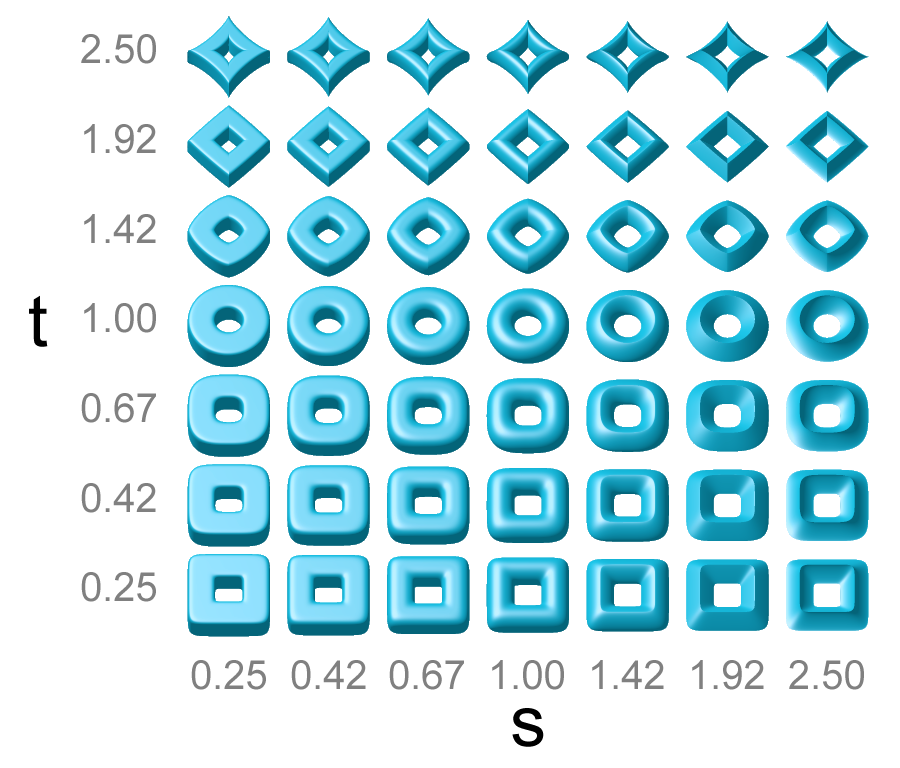
Parasolid is a geometric modeling kernel originally developed by Shape Data Limited, now owned and developed by Siemens Digital Industries Software. It can be licensed by other companies for use in their 3D computer graphics software products. Parasolid's abilities include model creation and editing utilities such as Boolean modeling operators, feature modeling support, advanced surfacing, thickening and hollowing, blending and filleting, and sheet modeling. It also incorporates modeling with mesh surfaces and lattices. Parasolid also includes tools for direct model editing, including tapering, offsetting, geometry replacement and removing feature details with automated regeneration of surrounding data. Parasolid also provides wide-ranging graphical and rendering support, including hidden-line, wireframe and drafting, tessellation, and model data inquiries. To use Parasolid effectively, software developers need knowledge of CAD in general, computational geometry, and topology. Parasolid is available for Windows (32-bit, 64-bit and AArch64), Linux (64-bit and AArch64), macOS (Apple silicon and Intel), iOS, and Android. == Parasolid XT format == Parasolid parts are normally saved in XT format, which usually has the file extension .X_T. The format is documented and open. There is also a binary version of the format, usually with an .X_B extension, which is somewhat more compact. Both .X_T and .X_B are used for parts files. == Applications == It is used in many computer-aided design (CAD), computer-aided manufacturing (CAM), computer-aided engineering (CAE), product visualization, and CAD data exchange packages. Notable uses include:
Novell File Reporter
Novell File Reporter (NFR) is software that allows network administrators to identify files stored on the network and generates reports regarding the size of individual files, file type, when files were last accessed, and where duplicates exist. Additionally, the File Reporter tracks storage volume capacity and usage. It is a component of the Novell File Management Suite. == How it works == Novell File Reporter examines and reports on terabytes of data via a central reporting engine (NFR Engine) and distributed agents (NFR Agents). The NFR Engine schedules the scans of file instances conducted by NFR Agents, processes and compiles the scans for reporting purposes, and provides report information to the user interface. In addition to the standard reports it can generate, the NFR Engine can also produce "trigger reports" in response to specific events (a server volume crossing a capacity threshold, for example). Accordingly, the NFR Engine monitors the data gathered by the NFR Agents in order to identify these "triggers." The NFR Engine when working in either eDirectory or Active Directory connects to the directory via a Directory Services Interface (DSI) and thus can monitor and check file permissions.