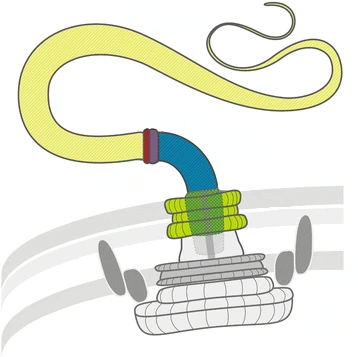
Cloud-Based Secure File Transfer is a managed or hosted file transfer service that provides cloud storage that can be accessed via SSH File Transfer Protocol (SFTP). These services allow secure, reliable file transfers while offering the scalability, redundancy, and high availability of cloud infrastructure. == Technical overview == The evolution of file transfer protocols began with File Transfer Protocol (FTP) and SSH File Transfer Protocol (SFTP). SFTP offered enhanced security through the use of SSH (Secure Shell) encryption, which addressed many of the security concerns associated with traditional FTP. Over time, as businesses increasingly adopted cloud infrastructure, the demand for services that integrate secure file transfer with cloud storage led to the rise of Cloud-Based Secure File Transfer services. These services combine the benefits of secure, encrypted file transfer with the scalability and flexibility of cloud-based storage systems. Traditional on-premises SFTP typically involves setting up and managing physical or virtual servers to handle file transfers. In contrast, Cloud-Based Secure File Transfer utilizes managed cloud infrastructure, such as AWS EC2, Azure VMs, or Google Cloud, to automate scaling, ensure redundancy, and provide high availability. These cloud environments can be configured to automatically scale with demand, enabling businesses to handle large volumes of data transfers without the need for extensive physical hardware. == Features == Scalability and availability: Cloud-Based Secure File Transfer services are inherently scalable, with features like load balancing, multi-region deployments, and auto-scaling groups that adjust resources in response to traffic spikes. This ensures that the system can handle varying workloads and provides continuous availability, even during high-demand periods. Cost-effectiveness: By eliminating the need for physical infrastructure and reducing ongoing server maintenance costs, Cloud-Based Secure File Transfer services offer significant cost savings compared to traditional on-premises services. Cloud providers typically offer pay-as-you-go pricing models, where users only pay for the resources they use, further optimizing costs. Security and compliance: Cloud-Based Secure File Transfer products offer strong security measures, including end-to-end encryption, key management, detailed logging, and auditing. These services are often compliant with industry regulations such as HIPAA (Health Insurance Portability and Accountability Act), GDPR (General Data Protection Regulation), and SOC 2 (System and Organization Controls), ensuring that data transfers meet necessary security and privacy standards. == Cloud-Based Secure File Transfer providers == == Uses == Cloud-Based Secure File Transfer is used across various industries to securely transfer sensitive data and integrate into business workflows. In healthcare, Cloud-Based Secure File Transfer is essential for securely transferring electronic Protected Health Information (ePHI), ensuring compliance with regulations like HIPAA. In financial institutions, it is used to protect sensitive financial data during transfer, maintaining privacy and security. Data analytics also benefits from Cloud-Based Secure File Transfer, offering a secure and efficient method for transferring large datasets between systems or partners. Technically, Cloud-Based Secure File Transfer is often integrated into enterprise workflows through automated file transfers, using scripting or APIs. It also plays a key role in cloud backup and disaster recovery, ensuring that files are securely transferred and stored in cloud environments, which supports business continuity. However, businesses must address certain implementation challenges. Despite its secure design, Cloud-Based Secure File Transfer is not immune to risks such as misconfigured SSH keys, improper access control, or inadequate encryption. Regular security audits and careful configuration management are necessary to minimize the risk of data breaches. Additionally, integrating Cloud-Based Secure File Transfer with legacy systems can present challenges, such as incompatible APIs or outdated authentication methods. == Comparisons with related technologies == Cloud-Based Secure File Transfer differs from traditional SFTP primarily in its deployment and management model. Traditional SFTP services are typically hosted on-premises or on virtual servers, requiring manual configuration, ongoing infrastructure maintenance, and security management by in-house IT teams. In contrast, Cloud-Based Secure File Transfer is offered as a Software-as-a-Service (SaaS) service, reducing infrastructure overhead by eliminating the need for dedicated hardware or virtual machines. This model simplifies management through centralized web-based interfaces, automated updates, and built-in scalability. While Cloud-Based Secure File Transfer is focused on providing secure file transfers over the SFTP protocol, Managed File Transfer (MFT) platforms generally support a broader range of protocols, including FTP, FTPS, HTTP/S, and AS2. MFT services often include advanced features such as end-to-end encryption, extensive automation, compliance reporting, and integration with enterprise systems. Cloud-Based Secure File Transfer services may offer some of these features but are typically more lightweight and streamlined, targeting organizations seeking a secure and scalable alternative to traditional SFTP without the full suite of MFT capabilities. As such, Cloud-Based Secure File Transfer can be seen as a specialized subset within the broader managed file transfer ecosystem.
Attack path management
Attack path management is a cybersecurity technique that involves the continuous discovery, mapping, and risk assessment of identity-based attack paths. Attack path management is distinct from other computer security mitigation strategies in that it does not rely on finding individual attack paths through vulnerabilities, exploits, or offensive testing. Rather, attack path management techniques analyze all attack paths present in an environment based on active identity management policies, authentication configurations, and active authenticated "sessions" between objects. == Overview == Attack path management relies on concepts such as mapping and removing attack paths, identifying attack path choke points, and remediation of attack paths. Identity-based attacks are present in most publicly disclosed breaches, whether through social engineering to gain initial access to Active Directories or lateral movement for privilege escalation. Attackers require privileges to attack an environment’s most sensitive segments. Attack path management often involves removing out-of-date privileges and privilege assignments given to overly large groups. In attack path management, attack graphs are used to represent how a network of machines’ security is vulnerable to attack. The nodes in an attack graph represent principals and other objects such as machines, accounts, and security groups. The edges in an attack graph represent the links and relationships between nodes. Some nodes are easy to penetrate due to short paths from regular users to domain admins, resulting in focal points of concentrated network traffic, which are known as attack path choke points. Attack graphs are often analyzed using algorithms and visualization. Attack path management also identifies tier 0 assets, which are considered the most vulnerable because they have direct or indirect control of an Active Directory or Microsoft Entra ID environment.
Peñabot
Peñabot is the nickname for automated social media accounts allegedly used by the Mexican government of Enrique Peña Nieto and the PRI political party to keep unfavorable news from reaching the Mexican public. Peñabot accusations are related to the broader issue of fake news in the 21st century. == History of disinformation in Mexican politics == The PRI political party has been reported to use fake news since before Peña Nieto. The main tactic originally was to spread such propaganda through open radio and television networks. Such tactic was effective in Mexico, because newspaper readership is low and cable TV is largely limited to the middle classes; consequently, the country's two major television networks – Televisa and TV Azteca – exert a significant influence in national politics. Televisa itself, not only owns around two-thirds of the programming on Mexico's TV channels, making it not only Mexico's largest television network, but also is the largest media network in the Spanish-speaking world. == Peñabots == Analysts have given the name Peñabots to a suspected network of automated accounts on social media used by the Mexican government to spread pro-government propaganda and to marginalize dissenting opinions in social media. The bots were first noticed in the 2012 elections when they were used to disseminate opinions in support of Enrique Peña Nieto on social networks such as Twitter and Facebook. According to Aristegui Noticias, their usage went against articles 6 and 134 of the Mexican Constitution. Those used by Peña Nieto's government cost an estimated 80 million pesos monthly, which news outlets argued only helped the government spread fake support towards the president, but did not have a benefit towards Mexican people (with whom EPN was highly unpopular). Facebook held approximately 640,321 Peñabots, while Twitter had less. As of July 2017, Oxford Internet Institute's Computational Propaganda Research Project claimed many western democracies, Mexico included, perform social media manipulation, thus saying the manipulation comes directly from the Mexican government itself. During Peña Nieto's subsequent presidency, analysts noted that Peñabots were used to overpower trending topics that critiqued government, to flood trending government critical hashtags with spam, to create fake trends by pushing alternative hashtags, and to push smear campaigns and threats against government-critical activists and journalists. Peñabots were distinguished as their pattern of activity was distinct from that of ordinary interaction on social networks. === Meadebots === On Twitter it was reported that about 94% of the followers of 2018 presidential candidate from the PRI Jose Antonio Meade were bots. When Antonio Meade presented himself as a candidate for the 2018 presidential election, his social media accounts such as "@MovimientoMEADE" (created by the PRI's official account @PRI_Nacional), obtained a huge quantity of followers in a short span of time. Some users noticed and brought it to attention, and after investigation it was reported 94% of such followers were bots (702,000 out of 747,000), and the account was eliminated from Twitter after 20 hours. The fake accounts used the hashtags #YoConMeade and #Meade18. It was further revealed was that Meade's official account on Twitter, @JoseAMeadeK had 25% bots (216,000 fake followers out of the 981,000). == Manipulation of news media in Mexico, through television == The Mexican government of Peña Nieto has been accused of using various means to keep unfavorable news from reaching the Mexican people. Many Mexicans have protested this practice as it clearly goes against the freedom of speech. The PRI has been reported to use fake news since before Peña Nieto. The main tactic has been to spread such propaganda through radio and television. This tactic is perceived as effective in Mexico, because newspaper readership is low and research on the Internet and cable TV is largely limited to the middle classes; consequently, the country's two major television networks – Televisa and TV Azteca – exert a significant influence in national politics. Televisa itself, owns around two-thirds of the programming on Mexico's TV channels, making it not only Mexico's largest television network, but also is the largest media network in the Spanish-speaking world. In June 2012, before the 2012 Mexican presidential elections, the British newspaper The Guardian published a series of allegations claiming Televisa, sold favorable coverage to top politicians in its news and entertainment shows, this scandal became known as the Televisa controversy. The documents published by 'The Guardian alleged that a secretive circle within Televisa manipulated news coverage to favor PRI presidential candidate Enrique Peña Nieto, who was poised as favorite to win. Televisa's secret circle supposedly commissioned videos to promote Peña Nieto and lash out his political rivals in 2009. The Guardian documents suggest that Televisa's secret team distributed such videos through e-mail, posting them posted them on Facebook and YouTube, some can still be seen there. Another document was a PowerPoint presentation, with a slide explicitly aimed at rival leftist candidate of the Party of the Democratic Revolution (PRD), Andrés Manuel López Obrador. Supposedly given to The Guardian by a Televisa employee. The document's authenticity was never possible to confirm– however dates, names, and events largely coincide. Televisa refused to talk the documents, and denied a relationship with the PRI or its presidential candidate, saying that they had provided equal media coverage to all parties. Televisa published an article supposedly showing discrepancies in The Guardian documents and denying accusations. Mexican citizens complained about the perceived favoritism towards Enrique Peña Nieto and the PRI, protesting through the Yo Soy 132 movement which Televisa covered in detail. However, Televisa's news media coverage is perceived to have been biased, by using a media coverage tactic Mexican citizens call cortinas de humo (smoke screens). These introduce a news scandal giving extensive coverage to distract citizens from a potential conflict-of-interest or controversy that could damage the image of the politician favored by the network. An example of a perceived smoke screen would be the news media coverage of "Caso Michoacán" and "Caso Paolette" distracting all the attention from the parallel "Yo soy 132" movement. A few years later, on the day of September 11, 2016; factual evidence of Televisa's performing media manipulation emerged, when a Televisa news anchor while live-on air reading a teleprompter, mistakenly read out loud that "try that Jaime "Ël Bronco" Rodríguez Calderón (Nuevo Leon's governor) is mentioned as little as possible". Newspaper El Universal caught it on video and published it social media. Televisa didn't mention the story and declined to comment. Lack of news coverage concerning Nuevo León's Governor Jaime Rodriguez, is perceived due to him being the first elected governor to not be part of any political party (Independent Governor), and because unlike the governors from the PRI preceding him, the independent governor "El Bronco" doesn't spend money on publicity at all, preferring to communicate all news by using social media such as Twitter and Facebook. While the incident may have proven Televisa's bias, there wasn't anything to incriminate the PRI political party or Enrique Peña Nieto, though it did further suspicion of Televisa manipulating news media. In contrast, a December 2017 article of The New York Times, reported Enrique Peña Nieto spending about 2000 million dollars on publicity, during his first 5 years as president, the largest publicity budget ever spent by a Mexican President. Additionally, 68 percent of news journalists admitted to not believe to have enough freedom of speech, and award-winning news reporter Carmen Aristegui was controversially fired shortly after revealing the Mexican White House scandals. == Violence and spying towards news journalists and civil rights activists == Far for only being receiving accusations of spreading fake news, the Mexican government of EPN (Enrique Peña Nieto) has also been accused of violence towards news journalists, and of spying on them, and also towards civil right leaders and their families. During his tenure as president, Peña Nieto has been accused of failing to protect news journalists, whose deaths are speculated to be politically triggered, by politicians attempting to prevent them from covering political scandals. The New York Times published a news report on the matter titled, "In Mexico it's easy to kill a journalist", on it mentioning how during EPN's government, Mexico became one of the worst countries on which to be a journalist. The assassination of journalist Javier Valdez on May 23, 2017, received national coverage, with multiple news journalists
Data proliferation
Data proliferation refers to the prodigious amount of data, structured and unstructured, that businesses and governments continue to generate at an unprecedented rate and the usability problems that result from attempting to store and manage that data. While originally pertaining to problems associated with paper documentation, data proliferation has become a major problem in primary and secondary data storage on computers. While digital storage has become cheaper, the associated costs, from raw power to maintenance and from metadata to search engines, have not kept up with the proliferation of data. Although the power required to maintain a unit of data has fallen, the cost of facilities which house the digital storage has tended to rise. Data proliferation has been documented as a problem for the U.S. military since August 1971, in particular regarding the excessive documentation submitted during the acquisition of major weapon systems. Efforts to mitigate data proliferation and the problems associated with it are ongoing. == Problems caused == The problem of data proliferation is affecting all areas of commerce as a result of the availability of relatively inexpensive data storage devices. This has made it very easy to dump data into secondary storage immediately after its window of usability has passed. This masks problem that could gravely affect the profitability of businesses and the efficient functioning of health services, police and security forces, local and national governments, and many other types of organizations. Data proliferation is problematic for several reasons: Difficulty when trying to find and retrieve information. At Xerox, on average it takes employees more than one hour per week to find hard-copy documents, costing $2,152 a year to manage and store them. For businesses with more than 10 employees, this increases to almost two hours per week at $5,760 per year. In large networks of primary and secondary data storage, problems finding electronic data are analogous to problems finding hard copy data. Data loss and legal liability when data is disorganized, not properly replicated, or cannot be found promptly. In April 2005, the Ameritrade Holding Corporation told 200,000 current and past customers that a tape containing confidential information had been lost or destroyed in transit. In May of the same year, Time Warner Incorporated reported that 40 tapes containing personal data on 600,000 current and former employees had been lost en route to a storage facility. In March 2005, a Florida judge hearing a $2.7 billion lawsuit against Morgan Stanley issued an "adverse inference order" against the company for "willful and gross abuse of its discovery obligations." The judge cited Morgan Stanley for repeatedly finding misplaced tapes of e-mail messages long after the company had claimed that it had turned over all such tapes to the court. Increased manpower requirements to manage increasingly chaotic data storage resources. Slower networks and application performance due to excess traffic as users search and search again for the material they need. High cost in terms of the energy resources required to operate storage hardware. A 100 terabyte system will cost up to $35,040 a year to run—not counting cooling costs. == Proposed solutions == Applications that better utilize modern technology Reductions in duplicate data (especially as caused by data movement) Improvement of metadata structures Improvement of file and storage transfer structures User education and discipline The implementation of Information Lifecycle Management solutions to eliminate low-value information as early as possible before putting the rest into actively managed long-term storage in which it can be quickly and cheaply accessed.
Kerckhoffs's principle
Kerckhoffs's principle (also called Kerckhoffs's desideratum, assumption, axiom, doctrine or law) of cryptography was stated by the Dutch cryptographer Auguste Kerckhoffs in the 19th century. The principle holds that a cryptosystem should be secure, even if everything about the system, except the key, is public knowledge. This concept is widely embraced by cryptographers, in contrast to security through obscurity, which is not. Kerckhoffs's principle was phrased by the American mathematician Claude Shannon as "the enemy knows the system", i.e., "one ought to design systems under the assumption that the enemy will immediately gain full familiarity with them". In that form, it is called Shannon's maxim. Another formulation by American researcher and professor Steven M. Bellovin is: In other words—design your system assuming that your opponents know it in detail. (A former official at NSA's National Computer Security Center told me that the standard assumption there was that serial number 1 of any new device was delivered to the Kremlin.) == Origins == The invention of telegraphy radically changed military communications and increased the number of messages that needed to be protected from the enemy dramatically, leading to the development of field ciphers which had to be easy to use without large confidential codebooks prone to capture on the battlefield. It was this environment which led to the development of Kerckhoffs's requirements. Auguste Kerckhoffs was a professor of German language at Ecole des Hautes Etudes Commerciales (HEC) in Paris. In early 1883, Kerckhoffs's article, La Cryptographie Militaire, was published in two parts in the Journal of Military Science, in which he stated six design rules for military ciphers. Translated from French, they are: The system must be practically, if not mathematically, indecipherable; It should not require secrecy, and it should not be a problem if it falls into enemy hands; It must be possible to communicate and remember the key without using written notes, and correspondents must be able to change or modify it at will; It must be applicable to telegraph communications; It must be portable, and should not require several persons to handle or operate; Lastly, given the circumstances in which it is to be used, the system must be easy to use and should not be stressful to use or require its users to know and comply with a long list of rules. Some are no longer relevant given the ability of computers to perform complex encryption. The second rule, now known as Kerckhoffs's principle, is still critically important. == Explanation of the principle == Kerckhoffs viewed cryptography as a rival to, and a better alternative than, steganographic encoding, which was common in the nineteenth century for hiding the meaning of military messages. One problem with encoding schemes is that they rely on humanly-held secrets such as "dictionaries" which disclose for example, the secret meaning of words. Steganographic-like dictionaries, once revealed, permanently compromise a corresponding encoding system. Another problem is that the risk of exposure increases as the number of users holding the secrets increases. Nineteenth century cryptography, in contrast, used simple tables which provided for the transposition of alphanumeric characters, generally given row-column intersections which could be modified by keys which were generally short, numeric, and could be committed to human memory. The system was considered "indecipherable" because tables and keys do not convey meaning by themselves. Secret messages can be compromised only if a matching set of table, key, and message falls into enemy hands in a relevant time frame. Kerckhoffs viewed tactical messages as only having a few hours of relevance. Systems are not necessarily compromised, because their components (i.e. alphanumeric character tables and keys) can be easily changed. === Advantage of secret keys === Using secure cryptography is supposed to replace the difficult problem of keeping messages secure with a much more manageable one, keeping relatively small keys secure. A system that requires long-term secrecy for something as large and complex as the whole design of a cryptographic system obviously cannot achieve that goal. It only replaces one hard problem with another. However, if a system is secure even when the enemy knows everything except the key, then all that is needed is to manage keeping the keys secret. There are a large number of ways the internal details of a widely used system could be discovered. The most obvious is that someone could bribe, blackmail, or otherwise threaten staff or customers into explaining the system. In war, for example, one side will probably capture some equipment and people from the other side. Each side will also use spies to gather information. If a method involves software, someone could do memory dumps or run the software under the control of a debugger in order to understand the method. If hardware is being used, someone could buy or steal some of the hardware and build whatever programs or gadgets needed to test it. Hardware can also be dismantled so that the chip details can be examined under the microscope. === Maintaining security === A generalization some make from Kerckhoffs's principle is: "The fewer and simpler the secrets that one must keep to ensure system security, the easier it is to maintain system security." Bruce Schneier ties it in with a belief that all security systems must be designed to fail as gracefully as possible: Kerckhoffs's principle applies beyond codes and ciphers to security systems in general: every secret creates a potential failure point. Secrecy, in other words, is a prime cause of brittleness—and therefore something likely to make a system prone to catastrophic collapse. Conversely, openness provides ductility. Any security system depends crucially on keeping some things secret. However, Kerckhoffs's principle points out that the things kept secret ought to be those least costly to change if inadvertently disclosed. For example, a cryptographic algorithm may be implemented by hardware and software that is widely distributed among users. If security depends on keeping that secret, then disclosure leads to major logistic difficulties in developing, testing, and distributing implementations of a new algorithm – it is "brittle". On the other hand, if keeping the algorithm secret is not important, but only the keys used with the algorithm must be secret, then disclosure of the keys simply requires the simpler, less costly process of generating and distributing new keys. == Applications == In accordance with Kerckhoffs's principle, the majority of civilian cryptography makes use of publicly known algorithms. By contrast, ciphers used to protect classified government or military information are often kept secret (see Type 1 encryption). However, it should not be assumed that government/military ciphers must be kept secret to maintain security. It is possible that they are intended to be as cryptographically sound as public algorithms, and the decision to keep them secret is in keeping with a layered security posture. == Security through obscurity == It is moderately common for companies to keep the inner workings of a system secret. Some argue this "security by obscurity" makes the product safer and less vulnerable to attack. A counter-argument is that keeping the innards secret may improve security in the short term, but in the long run, only systems that have been published and analyzed should be trusted. Steven Bellovin and Randy Bush commented: Security Through Obscurity Considered Dangerous Hiding security vulnerabilities in algorithms, software, and/or hardware decreases the likelihood they will be repaired and increases the likelihood that they can and will be exploited. Discouraging or outlawing discussion of weaknesses and vulnerabilities is extremely dangerous and deleterious to the security of computer systems, the network, and its citizens. Open Discussion Encourages Better Security The long history of cryptography and cryptoanalysis has shown time and time again that open discussion and analysis of algorithms exposes weaknesses not thought of by the original authors, and thereby leads to better and more secure algorithms. As Kerckhoffs noted about cipher systems in 1883 [Kerc83], "Il faut qu'il n'exige pas le secret, et qu'il puisse sans inconvénient tomber entre les mains de l'ennemi." (Roughly, "the system must not require secrecy and must be able to be stolen by the enemy without causing trouble.")
Distributed file system for cloud
A distributed file system for cloud is a file system that allows many clients to have access to data and supports operations (create, delete, modify, read, write) on that data. Each data file may be partitioned into several parts called chunks. Each chunk may be stored on different remote machines, facilitating the parallel execution of applications. Typically, data is stored in files in a hierarchical tree, where the nodes represent directories. There are several ways to share files in a distributed architecture: each solution must be suitable for a certain type of application, depending on how complex the application is. Meanwhile, the security of the system must be ensured. Confidentiality, availability and integrity are the main keys for a secure system. Users can share computing resources through the Internet thanks to cloud computing which is typically characterized by scalable and elastic resources – such as physical servers, applications and any services that are virtualized and allocated dynamically. Synchronization is required to make sure that all devices are up-to-date. Distributed file systems enable many big, medium, and small enterprises to store and access their remote data as they do local data, facilitating the use of variable resources. == Overview == === History === Today, there are many implementations of distributed file systems. The first file servers were developed by researchers in the 1970s. Sun Microsystem's Network File System became available in the 1980s. Before that, people who wanted to share files used the sneakernet method, physically transporting files on storage media from place to place. Once computer networks started to proliferate, it became obvious that the existing file systems had many limitations and were unsuitable for multi-user environments. Users initially used FTP to share files. FTP first ran on the PDP-10 at the end of 1973. Even with FTP, files needed to be copied from the source computer onto a server and then from the server onto the destination computer. Users were required to know the physical addresses of all computers involved with the file sharing. === Supporting techniques === Modern data centers must support large, heterogenous environments, consisting of large numbers of computers of varying capacities. Cloud computing coordinates the operation of all such systems, with techniques such as data center networking (DCN), the MapReduce framework, which supports data-intensive computing applications in parallel and distributed systems, and virtualization techniques that provide dynamic resource allocation, allowing multiple operating systems to coexist on the same physical server. === Applications === Cloud computing provides large-scale computing thanks to its ability to provide the needed CPU and storage resources to the user with complete transparency. This makes cloud computing particularly suited to support different types of applications that require large-scale distributed processing. This data-intensive computing needs a high performance file system that can share data between virtual machines (VM). Cloud computing dynamically allocates the needed resources, releasing them once a task is finished, requiring users to pay only for needed services, often via a service-level agreement. Cloud computing and cluster computing paradigms are becoming increasingly important to industrial data processing and scientific applications such as astronomy and physics, which frequently require the availability of large numbers of computers to carry out experiments. == Architectures == Most distributed file systems are built on the client-server architecture, but other, decentralized, solutions exist as well. === Client-server architecture === Network File System (NFS) uses a client-server architecture, which allows sharing of files between a number of machines on a network as if they were located locally, providing a standardized view. The NFS protocol allows heterogeneous clients' processes, probably running on different machines and under different operating systems, to access files on a distant server, ignoring the actual location of files. Relying on a single server results in the NFS protocol suffering from potentially low availability and poor scalability. Using multiple servers does not solve the availability problem since each server is working independently. The model of NFS is a remote file service. This model is also called the remote access model, which is in contrast with the upload/download model: Remote access model: Provides transparency, the client has access to a file. He sends requests to the remote file (while the file remains on the server). Upload/download model: The client can access the file only locally. It means that the client has to download the file, make modifications, and upload it again, to be used by others' clients. The file system used by NFS is almost the same as the one used by Unix systems. Files are hierarchically organized into a naming graph in which directories and files are represented by nodes. === Cluster-based architectures === A cluster-based architecture ameliorates some of the issues in client-server architectures, improving the execution of applications in parallel. The technique used here is file-striping: a file is split into multiple chunks, which are "striped" across several storage servers. The goal is to allow access to different parts of a file in parallel. If the application does not benefit from this technique, then it would be more convenient to store different files on different servers. However, when it comes to organizing a distributed file system for large data centers, such as Amazon and Google, that offer services to web clients allowing multiple operations (reading, updating, deleting,...) to a large number of files distributed among a large number of computers, then cluster-based solutions become more beneficial. Note that having a large number of computers may mean more hardware failures. Two of the most widely used distributed file systems (DFS) of this type are the Google File System (GFS) and the Hadoop Distributed File System (HDFS). The file systems of both are implemented by user level processes running on top of a standard operating system (Linux in the case of GFS). ==== Design principles ==== ===== Goals ===== Google File System (GFS) and Hadoop Distributed File System (HDFS) are specifically built for handling batch processing on very large data sets. For that, the following hypotheses must be taken into account: High availability: the cluster can contain thousands of file servers and some of them can be down at any time A server belongs to a rack, a room, a data center, a country, and a continent, in order to precisely identify its geographical location The size of a file can vary from many gigabytes to many terabytes. The file system should be able to support a massive number of files The need to support append operations and allow file contents to be visible even while a file is being written Communication is reliable among working machines: TCP/IP is used with a remote procedure call RPC communication abstraction. TCP allows the client to know almost immediately when there is a problem and a need to make a new connection. ===== Load balancing ===== Load balancing is essential for efficient operation in distributed environments. It means distributing work among different servers, fairly, in order to get more work done in the same amount of time and to serve clients faster. In a system containing N chunkservers in a cloud (N being 1000, 10000, or more), where a certain number of files are stored, each file is split into several parts or chunks of fixed size (for example, 64 megabytes), the load of each chunkserver being proportional to the number of chunks hosted by the server. In a load-balanced cloud, resources can be efficiently used while maximizing the performance of MapReduce-based applications. ===== Load rebalancing ===== In a cloud computing environment, failure is the norm, and chunkservers may be upgraded, replaced, and added to the system. Files can also be dynamically created, deleted, and appended. That leads to load imbalance in a distributed file system, meaning that the file chunks are not distributed equitably between the servers. Distributed file systems in clouds such as GFS and HDFS rely on central or master servers or nodes (Master for GFS and NameNode for HDFS) to manage the metadata and the load balancing. The master rebalances replicas periodically: data must be moved from one DataNode/chunkserver to another if free space on the first server falls below a certain threshold. However, this centralized approach can become a bottleneck for those master servers, if they become unable to manage a large number of file accesses, as it increases their already heavy loads. The load rebalance problem is NP-hard. In order to get a large number of chunkservers to work in collaboration, and to
SIPRNet
The Secret Internet Protocol Router Network (SIPRNet) is "a system of interconnected computer networks used by the U.S. Department of Defense and the U.S. Department of State to transmit classified information (up to and including information classified SECRET) by packet switching over the 'completely secure' environment". It also provides services such as hypertext document access and electronic mail. SIPRNet is a component of the Defense Information Systems Network. Other components handle communications with other security needs, such as the NIPRNet, which is used for nonsecure communications, and the Joint Worldwide Intelligence Communications System (JWICS), which is used for Top Secret communications. == Access == According to the U.S. Department of State Web Development Handbook, domain structure and naming conventions are the same as for the open internet, except for the addition of a second-level domain, like, e.g., "sgov" between state and gov: openforum.state.sgov.gov. Files originating from SIPRNet are marked by a header tag "SIPDIS" (SIPrnet DIStribution). A corresponding second-level domain smil.mil exists for DoD users. Access is also available to a "...small pool of trusted allies, including Australia, Canada, the United Kingdom and New Zealand...". This group (including the US) is known as the Five Eyes. SIPRNet was one of the networks accessed by Chelsea Manning, convicted of leaking the video used in WikiLeaks' "Collateral Murder" release as well as the source of the US diplomatic cables published by WikiLeaks in November 2010. == Alternate names == SIPRNet and NIPRNet are referred to colloquially as SIPPERnet and NIPPERnet (or simply sipper and nipper), respectively.